Storm Damage Restoration in Vandenberg Village
Storm damage restoration in Vandenberg Village and surrounding areas. Insurance billing accepted. Call (805) 345-7440.
A storm doesn’t announce how much damage it left behind. The tree limb through the roof is obvious, the water that followed it into the wall cavity for the next six hours is not. Storm damage restoration is the work of finding both: the visible destruction and the hidden moisture, structural compromise, and debris intrusion that keep causing problems long after the sky clears. Getting that full picture documented quickly is what determines whether your home recovers cleanly or develops secondary damage that costs twice as much to fix.
What Storm Damage Restoration actually involves
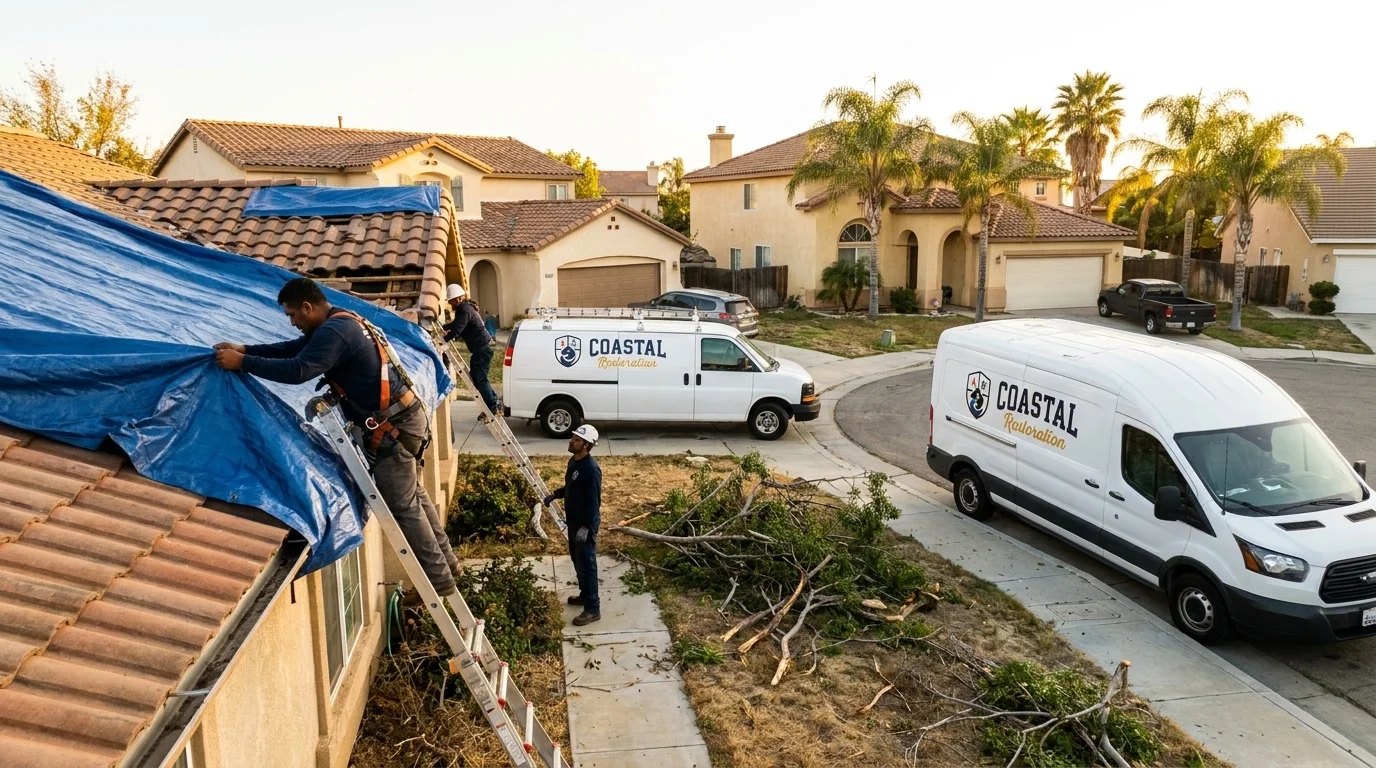
Storm damage is rarely one thing. A single event can combine wind-driven rain infiltration, impact damage from falling trees or debris, roof membrane failure, flooded crawlspaces, and broken windows, all at once, all interacting. The work involves tarping and boarding to stop active exposure, water extraction and drying for any intrusion that followed the breach, structural assessment of framing and sheathing, debris removal from the structure and immediate grounds, and documentation thorough enough to support an insurance claim.
Equipment on a storm job typically includes industrial air movers and dehumidifiers for any wet materials, moisture meters and thermal imaging cameras to map water migration behind walls and under flooring, and generators when utility power is out. On larger losses, a roof section gone, a tree through a living space, temporary weatherization with reinforced poly sheeting or OSB boarding happens first, before anything else.
Timeline varies with severity. Emergency stabilization (tarping, boarding, extraction) happens within the first hours. Structural drying, if water entered, runs three to five days on average for standard assemblies, longer for dense materials like hardwood subfloor or plaster. Full reconstruction scope is written after drying is confirmed complete, not before.
Our process
-
Emergency stabilization, The first priority is stopping ongoing exposure. That means tarping breached rooflines, boarding broken windows and doors, and sandbagging or diverting active water intrusion. Nothing else happens until the structure is no longer open to weather.
-
Damage mapping and documentation, Every affected surface is photographed and logged before any material is moved. Moisture readings are taken at multiple depths across all impacted assemblies. This documentation is not just for our scope, it becomes the evidentiary record your insurance adjuster works from.
-
Water extraction and structural drying, Any water that entered through the breach gets extracted immediately. Air movers and dehumidifiers are positioned to dry wall cavities, subfloor, and insulation to manufacturer and IICRC S500 drying targets. Readings are logged daily until materials reach equilibrium, drying is not called complete based on feel or appearance.
-
Debris removal and structural assessment, Once the interior is stabilized, exterior debris (fallen limbs, displaced roofing, shattered glass) is removed and the structural framing is evaluated. Any compromised rafters, joists, or wall studs are flagged in the scope before reconstruction begins.
-
Reconstruction scope and repair, With drying confirmed and structure assessed, a written scope of work is prepared covering everything from roofing and sheathing to drywall, insulation, paint, and finish carpentry. Work proceeds in trade sequence so inspections aren’t skipped and finishes aren’t applied over unresolved moisture.
What separates a good storm damage response from a bad one
The most common mistake on storm jobs is writing the reconstruction scope too early, before drying is complete and before all moisture migration is mapped. Water from a roof breach doesn’t stay where it lands. It follows framing, runs along vapor barriers, and pools in low points that may be two rooms away from the visible damage. Contractors who skip the drying phase and go straight to repair end up enclosing wet materials, which leads to mold colonization within 24 to 72 hours in the right conditions.
Insurance adjusters look for a few things that separate thorough documentation from a rough estimate: daily moisture logs with meter readings and GPS-tagged photos, a clear chain from the storm event to each damaged material, and a scope that separates emergency services from reconstruction line items. Adjusters also flag claims where temporary repairs weren’t made promptly, if a roof sat open for three days and the damage expanded, that secondary damage can be disputed.
On the structural side, experienced operators know to check not just what the tree hit, but what it hit on the way down. Rafters, ridge boards, and top plates absorb impact loads differently than sheathing, and a rafter that looks intact may have a compression fracture that doesn’t show until it’s under load again.
What does Storm Damage Restoration cost?
Typical costs run a wide range because storm losses vary more than almost any other restoration category, a single broken window is a different job than a tree through a roof with three days of water intrusion behind it. Most homeowners pay somewhere between $2,500 and $25,000 for storm damage restoration depending on the size of the breach, how long water was present, and how much structural repair is required. The table below reflects typical industry figures, not quotes.
| Scenario | Typical range |
|---|---|
| Minor wind damage, single roof section, no water intrusion | $1,500 – $4,000 |
| Tree limb impact, partial roof breach, limited water entry | $5,000 – $12,000 |
| Full tree-through-roof, significant water intrusion, framing damage | $15,000 – $40,000 |
| Hurricane or tornado damage, multiple systems affected | $30,000 – $100,000+ |
| Flood-driven storm surge, crawlspace or basement flooding | $4,000 – $18,000 |
| Window/door breach with wind-driven rain, interior drying only | $1,200 – $5,000 |
Every loss is different, and Coastal Restoration Services Inc provides a written scope of work before any restoration begins. Homeowners insurance typically covers sudden and accidental storm damage, wind, hail, falling trees, and resulting water intrusion, though flood damage from ground-level water generally requires a separate flood policy.
Seasonal and regional considerations
Vandenberg Village and the surrounding Santa Barbara County coast sit in a climate that doesn’t follow the Gulf Coast storm calendar, but that doesn’t mean low risk. The region’s threat profile is specific: atmospheric river events between November and March can deliver sustained rainfall that overwhelms aging roof systems and drainage, particularly on mid-century ranch homes common in Lompoc and Orcutt. Red Flag conditions in fall bring wind events capable of downing eucalyptus and pine onto structures. And because the area doesn’t see severe weather constantly, many roofs go years between inspections, which means storm damage often reveals deferred maintenance that was already failing.
Post-storm drying timelines can also run longer here than in drier inland climates. Marine layer humidity in the 70–85% range limits dehumidifier efficiency, which is why equipment sizing and daily monitoring matter more than they would in a desert climate.
Service area
Coastal Restoration Services Inc is based in Vandenberg Village and handles storm damage restoration throughout the surrounding region, including Lompoc, Orcutt, Santa Maria, Buellton, Solvang, and Goleta. Each city-specific service page links back here for the full process detail, the work is the same regardless of zip code.
If you’re looking at a roof breach, a tree on your structure, or wind-driven water inside your walls, call (805) 345-7440 to schedule your storm damage assessment. The sooner the scope is documented, the cleaner the claim, and the faster your home gets back to where it was.
Frequently Asked Questions
Does homeowners insurance cover storm damage restoration?
What's the difference between wind-driven rain damage and flood damage, and why does it matter for my claim?
How do I know if water got into my walls after a storm, even if I can't see visible damage?
Can a tree impact damage structural framing even if the roof looks intact from the outside?
How long does storm-related structural drying typically take, and what affects the timeline?
Looking for the best storm damage restoration company in Santa Maria?
Coastal Restoration Services Inc provides licensed and insured storm damage restoration in Santa Maria, CA and the surrounding area. Customers rate us 5.0 out of 5 stars across 29 Google reviews. We answer calls 24/7 — call (805) 345-7440 for immediate help.
Need Storm Damage Restoration now?
We respond 24/7 across Santa Maria and surrounding CA cities.
Related Coverage
- Our Restoration Services
- Contact Coastal Restoration Services Inc
- Storm Damage Restoration in Arroyo Grande
- Storm Damage Restoration in Atascadero
- Storm Damage Restoration in Avila Beach
- Storm Damage Restoration in Ballard
- Storm Damage Restoration in Blacklake
- Storm Damage Restoration in Buellton
- Storm Damage Restoration in Callender
- Storm Damage Restoration in Cambria
- Storm Damage Restoration in Edna
- Storm Damage Restoration in El Paso de Robles
- Storm Damage Restoration in Grover Beach
- Storm Damage Restoration in Guadalupe