
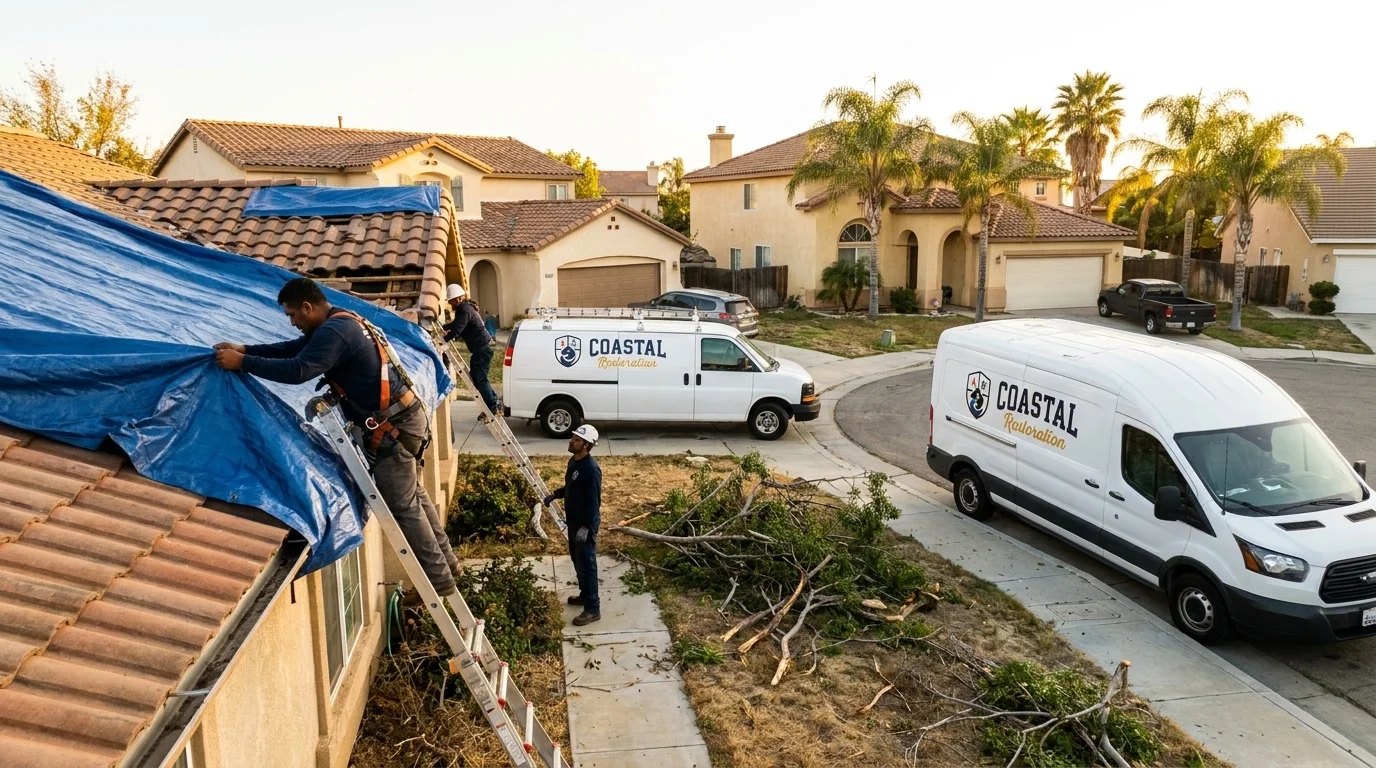
Storm Damage Restoration in Arroyo Grande
Storm damage restoration in Arroyo Grande, CA. Insurance billing accepted. Call (805) 345-7440.
Our IICRC-certified technicians are dispatched from our Santa Maria, CA headquarters and are typically on-site in Arroyo Grande within 60 minutes of your call.
Arroyo Grande sits in a narrow coastal valley where Pacific storm systems funnel off the ocean and stall against the Santa Lucia foothills, turning routine winter rain events into something more damaging than the forecast suggests. When a storm drops two inches of rain in three hours, not unusual here between November and March, the combination of saturated clay soils, aging drainage infrastructure, and the mix of mid-century ranch homes and newer hillside construction creates a specific kind of damage pattern: water pooling against foundations, wind-driven rain penetrating older wood-framed window assemblies, and debris from eucalyptus and pepper trees punching through rooflines. Coastal Restoration Services Inc responds to that pattern every season.
Why Arroyo Grande Properties See Concentrated Storm Damage
The geology here matters. Much of Arroyo Grande sits atop expansive clay soils that shed water quickly once they’re saturated, rather than absorbing runoff, the ground pushes it toward foundations, crawl spaces, and low-lying garages. Homes on the gentler slopes of the valley floor are especially vulnerable to subsurface intrusion during multi-day rain events, when the soil reaches its absorption limit early and every subsequent hour of rain becomes direct runoff.
The housing stock adds another layer. A significant share of Arroyo Grande’s residential properties were built in the 1950s through 1970s, when window flashing standards and roof-to-wall connections were less robust than current California Building Code requires. Wind-driven rain at 40–50 mph, common during the stronger Pineapple Express systems that hit the Central Coast, finds gaps in older flashing details that would hold fine in a standard vertical rain event. The result is water intrusion at wall penetrations, attic vents, and chimney flashings that doesn’t show up until interior drywall is already saturated.
Fallen trees are a consistent secondary hazard. The mature Monterey cypress and eucalyptus trees that shade older neighborhoods become projectiles when root systems are loosened by saturated soil. Roof punctures from falling limbs require immediate tarping and structural assessment before restoration work can begin, a step that affects both the insurance documentation process and the sequencing of interior drying.
Our Storm Damage Restoration Process in Arroyo Grande
Every storm job starts with a systematic exterior and interior assessment before any equipment is staged. For roof and structural breaches, we deploy temporary weatherproofing, reinforced poly tarps secured with batten strips, not just weighted down, to stop active water entry while documentation is completed. This matters for insurance claims: adjusters want to see that mitigation steps were taken promptly and correctly.
Once the structure is stabilized, interior moisture mapping comes next. We use thermal imaging and calibrated moisture meters to trace water migration through wall cavities, subfloor assemblies, and insulation, because water that entered through a roof breach on the south side of a house can travel twelve feet laterally before it shows up as a stain. In Arroyo Grande’s older ranch-style homes, which frequently have continuous attic spaces without fire blocking, that lateral travel can be extensive.
Drying equipment, commercial-grade desiccant or refrigerant dehumidifiers and high-velocity air movers, is positioned based on the moisture map, not placed generically. We monitor and log readings daily until materials reach target dryness levels consistent with industry drying standards. Structural repairs, from replacing sheathing and framing members to matching interior finishes, follow once the structure is confirmed dry.
Reaching Arroyo Grande from Vandenberg Village
Our team operates out of Vandenberg Village, which puts us on the 101 corridor with straightforward access to Arroyo Grande via the El Camino Real and Branch Street exits. For properties on the east side of the city near the Arroyo Grande Creek corridor, we typically route through Fair Oaks Avenue to avoid the congestion that backs up on Traffic Way during and immediately after major storm events, when demand for emergency services spikes and surface streets slow down. We schedule arrival windows honestly based on current conditions rather than quoting a minute figure that weather or traffic will invalidate.
Arroyo Grande Insurance Coordination
Storm damage claims on the Central Coast tend to involve a specific friction point: distinguishing pre-existing deferred maintenance (which carriers exclude) from acute storm damage (which they cover). We document both carefully, photographing the condition of materials adjacent to the damage zone, not just the damage itself, so the adjuster has a clear record of what the storm caused versus what was already present. We provide itemized scope-of-work documentation formatted to align with standard estimating platforms most residential carriers use, which reduces back-and-forth during the claims process.
Local Note
One pattern we see repeatedly in Arroyo Grande’s valley-floor properties: homes with raised wood-frame floors and unvented or poorly vented crawl spaces accumulate storm moisture for weeks after the rain event ends. The clay soil retains water at grade level, vapor migrates upward into the crawl, and subfloor framing begins to show elevated moisture readings long after the homeowner assumes the storm damage is resolved. If your home was built before 1980 and sits on a pier-and-beam foundation, a post-storm crawl space inspection is worth scheduling even if you didn’t see obvious interior water intrusion, what’s happening six inches below your floor can determine whether you’re dealing with a drying job now or a mold remediation job in three months.
If a storm has left your Arroyo Grande home with a compromised roof, standing water in a crawl space, or structural damage from a fallen tree, call Coastal Restoration Services Inc at (805) 345-7440. We’ll assess the damage, walk you through the documentation your insurance carrier needs, and get the work sequenced correctly so nothing is missed.
Serving Arroyo Grande from our Santa Maria headquarters — ★ 5.0 · 29 Google reviews
“We were very satisfied with the work they did. You would never know that we had a mold problem or that the lower 2 feet of our walls surrounding the refrigerator were replaced.” — Al, July 2026Read our reviews on Google →
Storm Damage Restoration in Arroyo Grande: Service Coverage
Frequently Asked Questions
How fast can you arrive for storm damage restoration in Arroyo Grande?
How does Arroyo Grande's clay soil affect storm damage to my foundation or crawl space?
My Arroyo Grande home was built in the 1960s — does that affect how storm water intrusion is repaired?
A eucalyptus tree fell on my roof during last night's storm — what's the first step?
How do you distinguish storm damage from pre-existing wear when working with my insurance adjuster in Arroyo Grande?
How long does storm damage drying typically take for a ranch-style home in Arroyo Grande?
Storm Damage Restoration response in Arroyo Grande
Most Arroyo Grande calls see a technician on-site within 60 minutes from our Santa Maria headquarters.