Water Damage Restoration in Vandenberg Village
Water damage restoration in Vandenberg Village and surrounding areas. Insurance billing accepted. Call (805) 345-7440.
You noticed the wet carpet at 11 p.m. By morning, the padding underneath is saturated, the subfloor has absorbed enough moisture to begin swelling, and, if the source was a washing machine supply line or a dishwasher drain, the water has already crept behind the toe kicks and into the wall cavity behind the cabinetry. Water damage moves faster than most homeowners expect, and the window to stop it from becoming a structural or microbial problem is measured in hours, not days.
What Water Damage Restoration actually involves
Water damage restoration is not mopping up and running a fan. It is a sequenced technical process, water removal, controlled structural drying, moisture monitoring, and documentation, designed to return a building to its pre-loss moisture condition without creating conditions for secondary damage like mold colonization or wood rot.
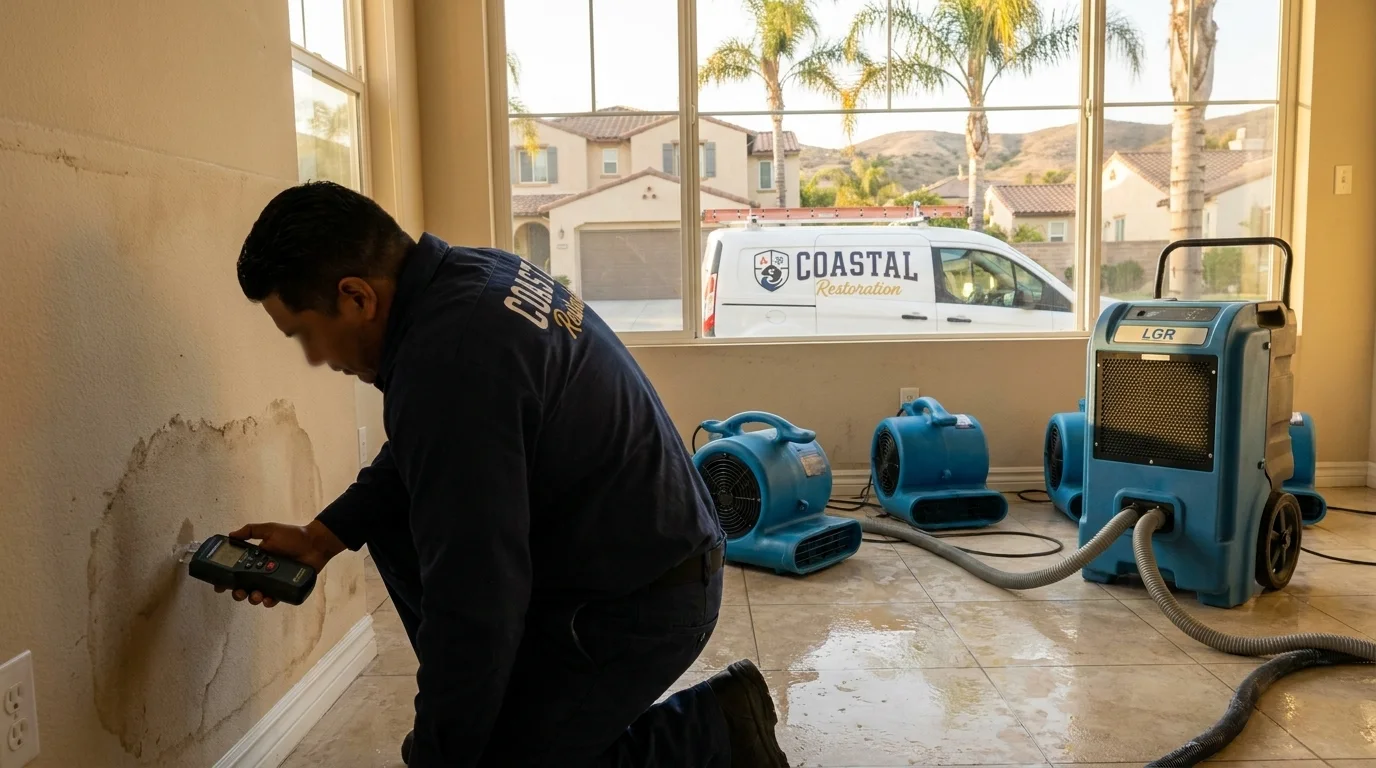
The equipment involved is industrial-grade: truck-mounted or portable extraction units that pull hundreds of gallons from flooring assemblies, low-grain refrigerant (LGR) dehumidifiers that drive ambient humidity down to levels where wet materials can release moisture into the air, and axial or centrifugal air movers positioned to create a drying vortex across wall cavities and floor systems. Thermal imaging cameras and non-invasive moisture meters map the moisture boundary, the actual edge of the wet zone, which is almost always larger than what is visible to the eye.
Timeline depends on the water category and the materials affected. Clean water (Category 1) in a single room with hardwood or carpet over concrete typically dries in three to five days under proper equipment loads. Category 2 losses, gray water from an appliance overflow or a toilet supply line, require more aggressive drying and antimicrobial treatment. Category 3 (sewage, floodwater, or any water that has been standing long enough to become grossly contaminated) involves containment protocols before extraction begins.
Our process
-
Moisture mapping and loss assessment. Before a single piece of equipment is placed, the affected area is mapped with moisture meters and thermal imaging. This documents the pre-drying baseline, identifies hidden wet zones inside walls and under flooring, and determines the water category, which drives every decision that follows.
-
Water extraction. Standing water and saturated materials are extracted using high-CFM equipment. For carpet and pad, this means weighted extraction to pull water from deep in the fiber and backing. For hard flooring with subfloor penetration, extraction is followed by a decision on whether flooring can be dried in place or must be removed to access the subfloor assembly.
-
Containment and antimicrobial treatment (Category 2/3). When the water source is gray or black water, the affected area is contained to prevent cross-contamination, and EPA-registered antimicrobials are applied to all affected surfaces before drying equipment is introduced. Porous materials that cannot be adequately sanitized, drywall below the flood cut line, contaminated insulation, are removed.
-
Structural drying with daily monitoring. Dehumidifiers and air movers are set to calculated equipment loads based on the cubic footage and material types in the drying chamber. Moisture readings are logged daily at each monitoring point. Equipment is adjusted or repositioned as materials dry unevenly. Drying is not complete until all monitored points reach the target grain reference equivalent (GRE), not just when materials feel dry to the touch.
-
Final documentation and clearance. A final moisture reading at every monitoring point is recorded and compared to the baseline. This documentation becomes part of the insurance claim file and confirms the structure has returned to an acceptable moisture condition before any reconstruction begins.
What separates a good water damage response from a bad one
The most common failure in water damage mitigation is under-scoping the wet zone. Moisture follows the path of least resistance, it travels along wall plates, wicks up drywall paper, and pools in floor system cavities that are invisible without a moisture meter. Operators who scope by eye alone routinely miss wet material that begins growing mold within 24 to 48 hours of the initial loss.
A second common failure is under-loading drying equipment. Placing one dehumidifier in a 1,200-square-foot loss and calling it done is not structural drying, it is hoping for the best. Proper equipment placement follows the IICRC S500 standard for psychrometric calculations, which accounts for the volume of wet material, ambient temperature, and the specific materials being dried.
Insurance adjusters look for daily moisture logs, equipment placement records, and a documented drying goal. A claim file without this data is difficult to supplement if secondary damage appears later. Thorough documentation protects the homeowner as much as the contractor.
Finally, the water category matters enormously. Treating a sewage backup as a clean-water loss, skipping containment and antimicrobial steps to save time, creates health and liability exposure that no amount of drying corrects afterward.
What does Water Damage Restoration cost?
Typical costs vary significantly based on the size of the affected area, the water category, the materials involved, and how quickly mitigation begins. Most homeowners pay somewhere in the ranges below for mitigation alone; reconstruction of removed materials is a separate scope.
| Scenario | Typical industry range |
|---|---|
| Single room, clean water (Category 1) | $1,200 – $3,500 |
| Multi-room, clean water, hardwood flooring | $3,500 – $7,500 |
| Category 2 loss (appliance overflow, gray water) | $2,500 – $6,000 |
| Category 3 / sewage backup, single bathroom | $3,000 – $8,000 |
| Crawl space or subfloor water intrusion | $2,000 – $5,500 |
| Whole-floor or multi-level loss | $8,000 – $20,000+ |
These are typical industry figures, every loss is different, and Coastal Restoration Services Inc provides a written scope of work before any work begins so there are no surprises. Standard homeowners insurance policies typically cover sudden and accidental water losses (burst pipes, appliance failures, roof leaks from a storm event) but generally exclude gradual leaks and ground-level flooding, which requires a separate flood policy.
Seasonal and regional considerations
Vandenberg Village and the surrounding Santa Barbara County coast sit in a climate that swings between long dry stretches and concentrated winter rain events. That pattern creates two distinct water damage seasons. From late November through March, atmospheric river storms can drive wind-driven rain into window frames, soffit vents, and aging roof assemblies faster than drainage systems can handle, interior flooding from roof and envelope failures spikes sharply during these events. The rest of the year, the dominant water loss source shifts to plumbing: supply lines on aging washing machines and refrigerators, water heaters that have exceeded their service life, and slab leaks in the post-war housing stock common in Lompoc and the Village itself.
The area’s moderate coastal humidity, typically 70–80% relative humidity on summer mornings, means that a wet building dries more slowly than it would in an inland desert climate. Equipment loads need to account for the ambient moisture load, and drying timelines that work in Bakersfield may need to be extended here.
Service area
Coastal Restoration Services Inc is based in Vandenberg Village and provides water damage restoration throughout the surrounding region, including Lompoc, Santa Maria, Orcutt, Buellton, Solvang, and Goleta. The location-specific pages for each city link back here for the full technical detail on our process, the work itself is the same regardless of zip code.
If you are seeing water where it does not belong, call (805) 345-7440 to schedule your moisture assessment. The sooner the wet zone is mapped and extraction begins, the smaller the scope of drying, and the lower the risk that today’s water loss becomes next month’s mold problem.
Frequently Asked Questions
Does homeowners insurance cover water damage restoration?
How long does structural drying typically take, and what affects the timeline?
What is the difference between Category 1, 2, and 3 water, and why does it change the cleanup process?
Can wet hardwood floors be dried in place, or do they always have to be removed?
What should I do — and not do — while waiting for the restoration crew to arrive?
Looking for the best water damage restoration company in Santa Maria?
Coastal Restoration Services Inc provides licensed and insured water damage restoration in Santa Maria, CA and the surrounding area. Customers rate us 5.0 out of 5 stars across 29 Google reviews. We answer calls 24/7 — call (805) 345-7440 for immediate help.
Need Water Damage Restoration now?
We respond 24/7 across Santa Maria and surrounding CA cities.
Related Coverage
- Our Restoration Services
- Contact Coastal Restoration Services Inc
- Water Damage Restoration in Arroyo Grande
- Water Damage Restoration in Atascadero
- Water Damage Restoration in Avila Beach
- Water Damage Restoration in Ballard
- Water Damage Restoration in Blacklake
- Water Damage Restoration in Buellton
- Water Damage Restoration in Callender
- Water Damage Restoration in Cambria
- Water Damage Restoration in Edna
- Water Damage Restoration in El Paso de Robles
- Water Damage Restoration in Grover Beach
- Water Damage Restoration in Guadalupe
- Burst Pipe Checklist: Step-by-Step Response
- What To Do in the First 24 Hours After Water Damage
- How To Choose a Restoration Company in (Without Getting Burned)