Storm Damage Restoration in Vandenberg AFB
Storm damage restoration in Vandenberg AFB, CA. Insurance billing accepted. Call (805) 345-7440.
Our IICRC-certified technicians are dispatched from our Santa Maria, CA headquarters and are typically on-site in Vandenberg AFB within 60 minutes of your call.
Vandenberg AFB sits along one of California’s most exposed stretches of coastline, where Pacific storm systems make landfall with little warning and even less mercy. The combination of salt-laden onshore winds, heavy seasonal rains, and the occasional atmospheric river event means that storm damage here isn’t just about broken branches, it’s about rooflines, saturated insulation, and water finding its way into structures that were built to military specification but weren’t designed to shed a week’s worth of rain in 48 hours. When a storm tears through the base and surrounding areas, Coastal Restoration Services Inc is based nearby in Vandenberg Village and ready to help you recover.
Why Vandenberg AFB Properties See Distinct Storm Damage Patterns
The geography of Vandenberg AFB creates conditions that amplify storm damage in ways that aren’t obvious until you’ve worked here. The base occupies a broad coastal terrace where wind accelerates as it comes off the ocean, and there’s very little natural windbreak before it hits structures. During strong Pacific fronts, sustained winds can strip roofing material, drive rain horizontally into window frames and exterior wall assemblies, and topple mature eucalyptus and Monterey cypress trees that have shallow root systems in the sandy coastal soils.
Those fallen trees are a recurring problem. The same sandy, well-drained soils that make the base’s terrain distinctive also mean large trees don’t anchor as deeply as they would in clay-heavy inland soils. A tree that looks healthy can uproot in a 50 mph gust and land on a roof, a fence line, or a vehicle. Tree damage cleanup in this environment often means coordinating debris removal before structural assessment can even begin.
Salt air compounds the damage timeline. Exposed metal fasteners, flashing, and HVAC components corrode faster here than they would 20 miles inland, so storm damage that might be cosmetic elsewhere can accelerate into a structural problem if it isn’t addressed within days.
Our Storm Damage Restoration Process at Vandenberg AFB
Every storm damage job starts with a thorough exterior and interior assessment, we’re looking at the roof deck, attic cavity, wall cavities, and any below-grade spaces where water may have migrated. On the Central Coast, storm water intrusion often travels farther than it appears on the surface; a compromised ridge cap can mean wet insulation two rooms away from the visible stain on the ceiling.
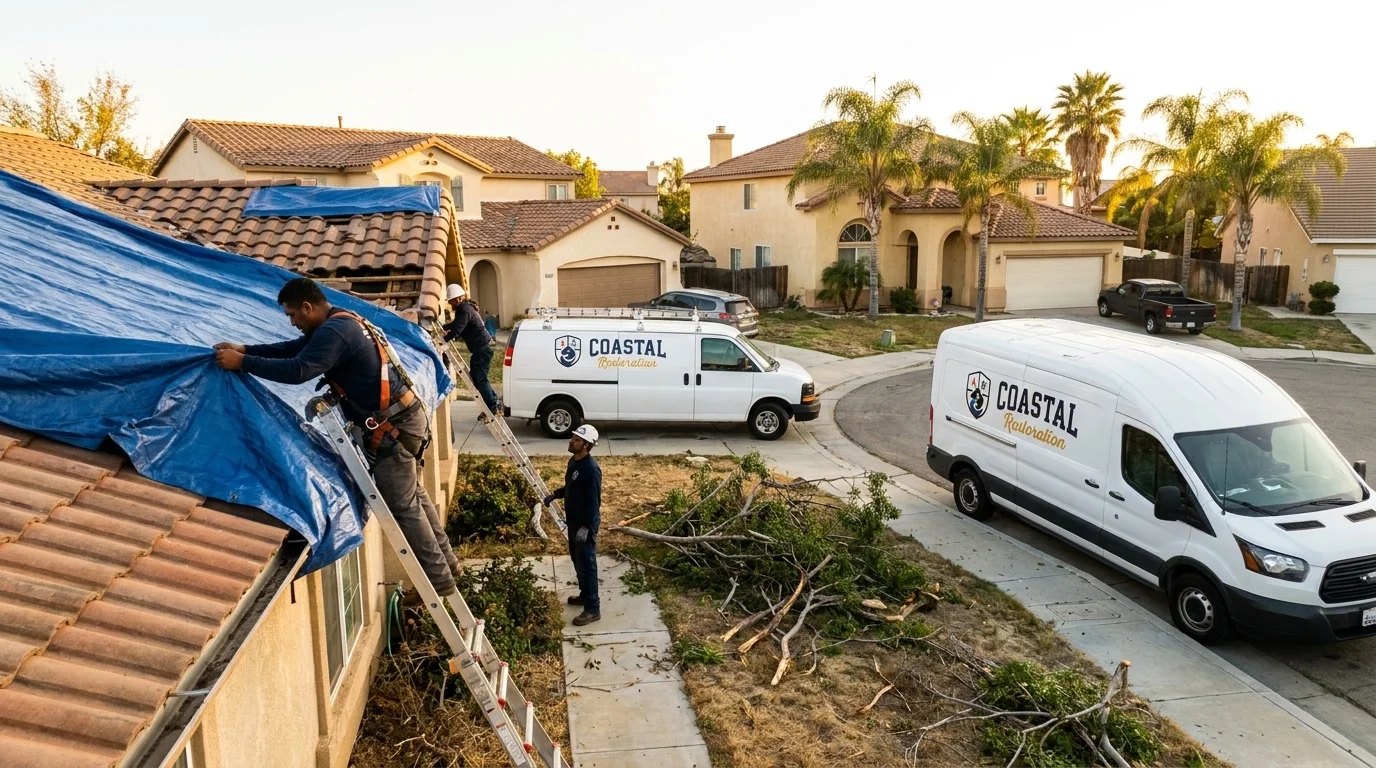
Once the scope is documented with photos and moisture readings, we move into debris removal and emergency weatherproofing. Tarping and board-up work happens fast because the Central Coast storm season doesn’t always give you a dry window between systems. We use commercial-grade tarps rated for coastal wind loads, not the lightweight polyethylene that fails in the next squall.
Drying and structural repair follow a sequenced process: extract standing water if present, deploy desiccant or refrigerant dehumidifiers appropriate to the space, monitor moisture levels in framing and sheathing daily, and only close up wall cavities once readings confirm the material is within acceptable range. Rushing that step is how mold colonizes behind a freshly painted wall.
Reaching Vandenberg AFB from Vandenberg Village
Our office in Vandenberg Village puts us close to the Highway 1 corridor that runs along the coast, which is the practical access route for most calls in this area. Depending on gate access and the nature of the work, coordination with base facilities management may be required before crews can mobilize onto the installation itself, we’re familiar with that process and factor it into scheduling so it doesn’t add unnecessary delay to your recovery timeline. For properties in the communities just outside the base boundary, access is straightforward and we can typically get eyes on the damage the same day you call.
Local Note: Coastal Soil and Foundation Drainage
One thing that catches property owners off guard after heavy storms at Vandenberg AFB is subsurface water migration. The sandy coastal soils drain quickly on the surface, which can make it look like the ground has dried out within a day or two of a storm. But that same drainage characteristic means water moves laterally underground and can pool against foundation walls, crawl spaces, and slab edges in ways that don’t show up until you’re inside the structure smelling the musty aftermath. We probe crawl spaces and check foundation perimeters as a standard part of our post-storm assessment here, it’s a step that’s easy to skip but consistently reveals hidden moisture in this specific coastal environment.
If your property at Vandenberg AFB took a hit in a recent storm, whether it’s a compromised roof, a downed tree, water in the walls, or damage you haven’t fully scoped yet, call Coastal Restoration Services Inc at (805) 345-7440. We know this coastline, we know how these storms behave, and we’ll give you a straight assessment of what needs to happen and in what order.
Serving Vandenberg AFB from our Santa Maria headquarters — ★ 5.0 · 29 Google reviews
“I was moving my washer when the water line snapped off the wall. Did not expect it to flood the way it did, it got bad pretty fast. First thing I thought about was mold, so I called CRS right away. I was pretty stressed when the owner Tony showed up but he immediately put me at ease. Walked me…” — Alejandro, July 2026Read our reviews on Google →
Storm Damage Restoration in Vandenberg AFB: Service Coverage
Frequently Asked Questions
How fast can you arrive for storm damage restoration in Vandenberg AFB?
Does working on Vandenberg AFB require special access coordination, and how does that affect the restoration timeline?
How does the coastal climate at Vandenberg AFB affect how quickly storm-damaged materials need to be dried?
Are tree damage and debris removal included in storm damage restoration at Vandenberg AFB, or is that a separate service?
Will my homeowner's or base housing insurance cover storm damage restoration at Vandenberg AFB?
What's the risk of mold after a storm at Vandenberg AFB, and how soon does it become a concern?
Storm Damage Restoration response in Vandenberg AFB
Most Vandenberg AFB calls see a technician on-site within 60 minutes from our Santa Maria headquarters.