Storm Damage Restoration in Nipomo
Storm damage restoration in Nipomo, CA. Insurance billing accepted. Call (805) 345-7440.
Our IICRC-certified technicians are dispatched from our Santa Maria, CA headquarters and are typically on-site in Nipomo within 60 minutes of your call.
Nipomo sits in a transitional coastal zone where Pacific storm systems sweeping up from the Channel Islands meet the warmer, drier air mass of the Santa Maria Valley, a combination that can turn a moderate winter storm into a localized event capable of snapping mature eucalyptus trees, flooding low-lying parcels, and driving wind-driven rain into roof assemblies that were never designed for sustained lateral moisture. When that happens, the damage compounds quickly: saturated insulation loses its R-value within hours, and wood framing in older ranch-style homes common to the area can begin to swell and warp before the skies even clear. Coastal Restoration Services Inc, based out of Vandenberg Village, responds to storm damage calls across Nipomo and the broader San Luis Obispo County coast.
Why Nipomo Properties See Distinct Storm Damage Patterns
Nipomo’s geography creates a specific set of vulnerabilities that differ from what you’d encounter in a typical inland Central Valley community. The area’s mesa terrain channels wind in ways that surprise homeowners who moved here from flatter regions, gusts accelerate as they cross open agricultural land and hit residential parcels with concentrated force. That means roof damage here often involves lifted flashing and compromised ridge caps rather than the wholesale shingle loss you see in higher-elevation communities.
Soil composition adds another layer of risk. Nipomo’s sandy loam, prized for agriculture, drains quickly under normal conditions but becomes unstable when saturated by a multi-day storm event. Fence posts and detached structure footings can shift, and surface runoff can undercut shallow concrete pads on older outbuildings. Homes built in the 1970s and 1980s, a substantial portion of the local housing stock, often have original composition shingles that are past their rated lifespan and are particularly susceptible to wind uplift and water intrusion during a strong Pacific low.
Our Storm Damage Restoration Process in Nipomo
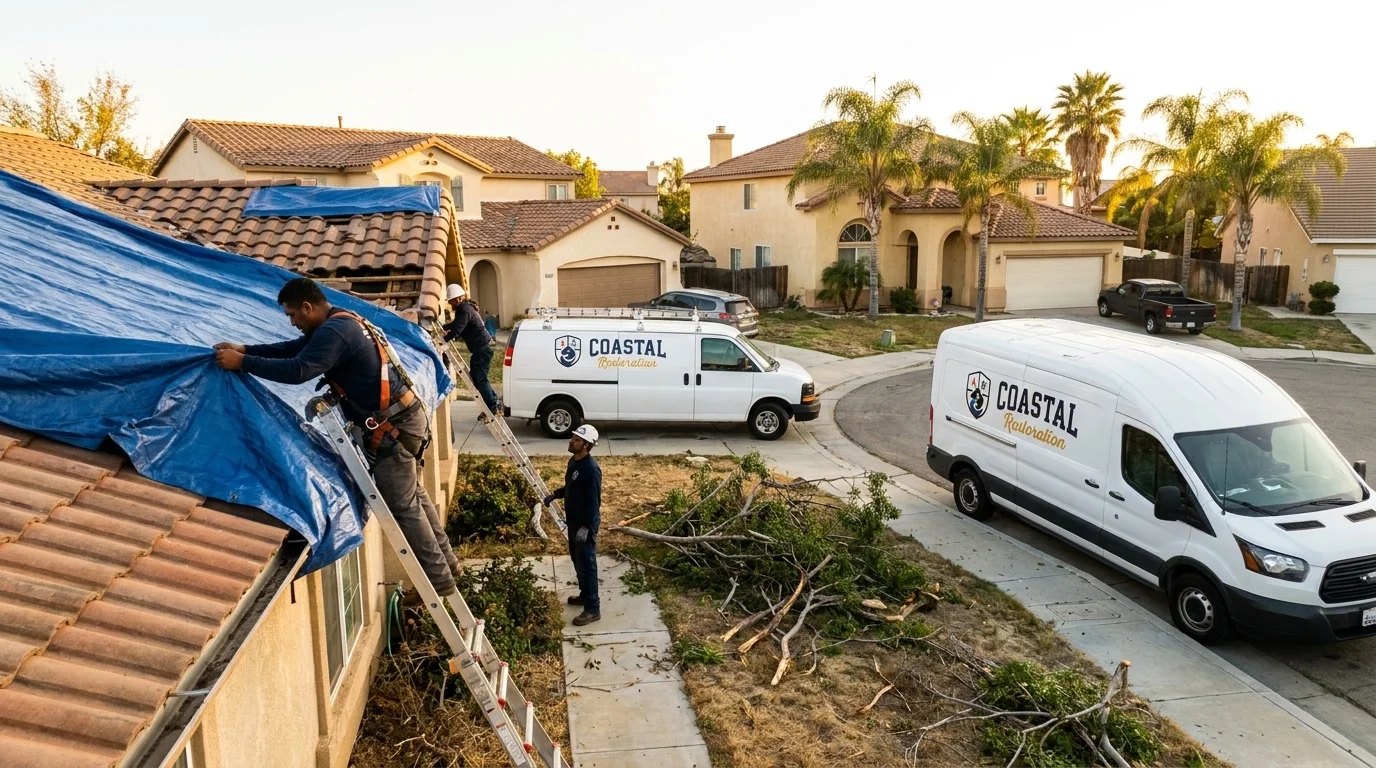
The first priority after a storm is stopping active water intrusion before secondary damage takes hold. Our crew performs an emergency tarp-and-board-up on any compromised roof sections or broken windows, then conducts a systematic interior assessment to locate moisture that has already migrated into wall cavities, attic spaces, and subfloor assemblies. We use thermal imaging cameras alongside calibrated moisture meters, moisture visible to the eye is rarely the full picture.
Once the structure is stabilized, we move into structured drying. Industrial desiccant dehumidifiers and high-velocity air movers are positioned based on a drying plan that accounts for the specific materials in your home, plaster, drywall, hardwood, and engineered flooring all release moisture at different rates and require different equipment configurations. We monitor and log readings daily so that drying progress is documented, which matters significantly when your insurance adjuster reviews the claim.
Tree and debris removal is coordinated in parallel. Nipomo’s mature eucalyptus and Monterey cypress are beautiful but brittle in high winds, and a downed limb on a roof or fence line needs to be cleared safely before structural repairs can begin. We work with licensed arborists for large canopy work and handle the resulting debris haul-off as part of the restoration scope.
Reaching Nipomo from Vandenberg Village
Our base in Vandenberg Village puts us on the US-1 / Highway 135 corridor, which connects directly south toward Nipomo via Santa Maria. Under normal post-storm traffic conditions, that route is straightforward. Following a significant storm event, however, Highway 1 through the Guadalupe corridor can experience localized flooding and debris on the roadway, in those situations, our crews use the Highway 101 inland route through Santa Maria to reach Nipomo without delay. We factor routing into our scheduling and communicate arrival windows clearly when you call.
Nipomo Insurance Coordination After Storm Events
Storm damage claims in San Luis Obispo County are processed through the same major carriers that cover the rest of California, but adjusters handling rural and semi-rural parcels like many in Nipomo sometimes schedule inspections with longer lead times than urban markets. That gap matters: if saturated materials aren’t dried and documented before the adjuster arrives, the visible evidence of the loss can diminish, which can complicate your claim.
We photograph and document every affected area before any material is moved or dried, creating a timestamped record that supports your claim. We also provide moisture readings and drying logs that adjusters and carriers recognize as standard documentation. If your policy includes an HOA master policy component, relevant for some of the newer planned communities in the Nipomo area, we can help clarify which portions of the loss fall under your individual policy versus the association’s coverage.
Local Note
One pattern we’ve noticed on Nipomo mesa properties specifically: the combination of sandy soil and older clay tile or composition roofing means that storm debris, pine needles, eucalyptus bark, and leaf litter, accumulates in valleys and gutters faster than homeowners expect. When a storm hits, that packed debris acts like a dam, forcing water back under the roofline rather than directing it to the downspout. The resulting intrusion point is almost always at the eave, not the ridge, which is counterintuitive and often missed in a visual inspection from the ground. If you’ve had standing water in your attic or water stains appearing at the top of interior walls near exterior corners, that debris-dam effect is often the culprit.
If your Nipomo property has taken storm damage, whether it’s a downed tree on the roof, water intrusion through a compromised wall assembly, or flooding in a garage or outbuilding, call Coastal Restoration Services Inc at (805) 345-7440. We’ll assess the damage, explain what needs to happen in plain terms, and get the work moving before the next weather system arrives.
Serving Nipomo from our Santa Maria headquarters — ★ 5.0 · 29 Google reviews
“Speedy work and very well done. Flexible with scheduling days and left very happy with the service. Recommend.” — Alejandra, July 2026Read our reviews on Google →
Storm Damage Restoration in Nipomo: Service Coverage
Frequently Asked Questions
How fast can you arrive for storm damage restoration in Nipomo?
How does Coastal Restoration Services Inc route to Nipomo after a major storm, and what affects arrival timing?
Nipomo has a lot of older ranch-style homes from the 1970s and 1980s — does that affect how storm damage restoration is handled?
Why does storm water intrusion in Nipomo sometimes appear at the eave rather than where the roof visibly failed?
How does Nipomo's sandy loam soil affect storm damage beyond the roof and walls?
If my Nipomo property has both an individual homeowner policy and an HOA master policy, how do you handle documentation for the claim?
Will my homeowners insurance cover storm damage restoration in Nipomo?
Storm Damage Restoration response in Nipomo
Most Nipomo calls see a technician on-site within 60 minutes from our Santa Maria headquarters.