
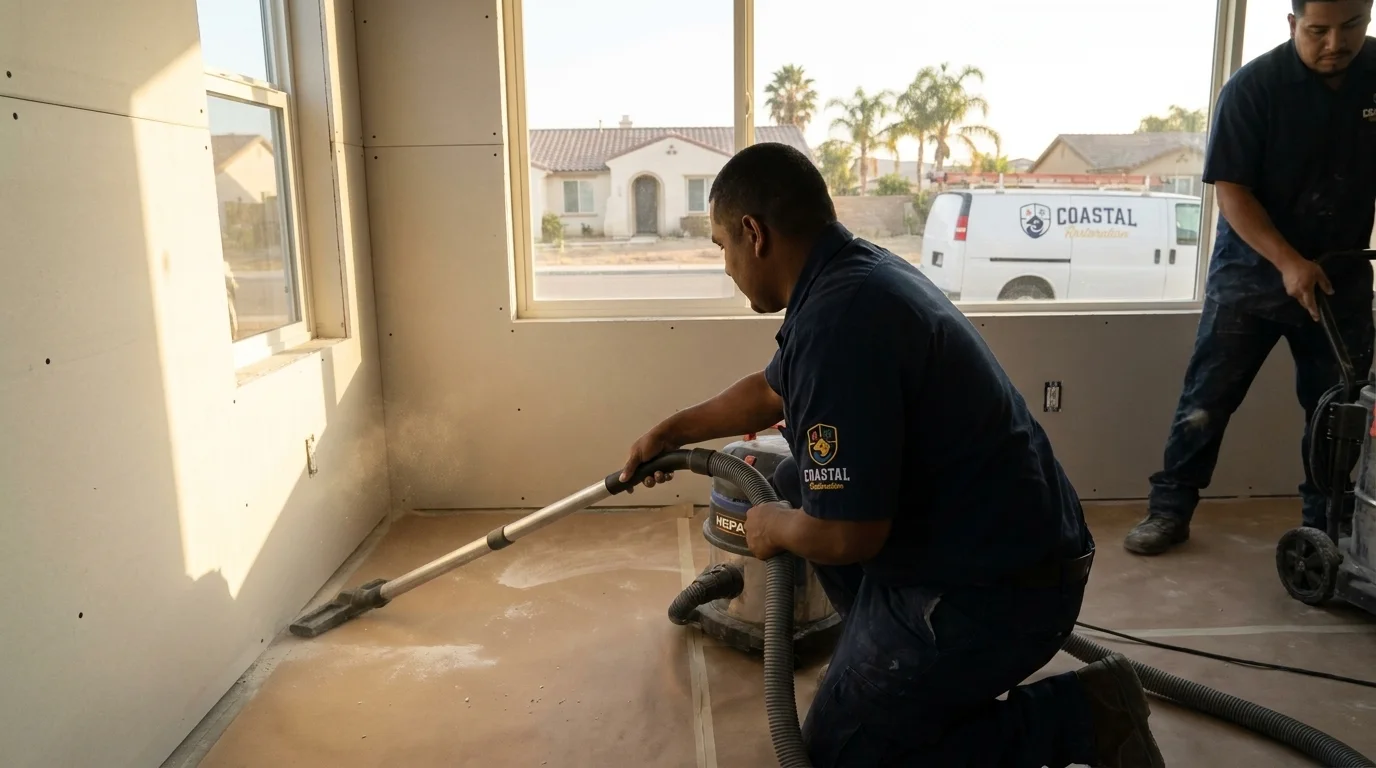
Post-Construction and Specialty Cleaning in Vandenberg Village
Post-construction and specialty cleaning in Vandenberg Village and surrounding areas. Insurance billing accepted. Call (805) 345-7440.
The contractor handed over the keys, the last subcontractor pulled out of the driveway, and now you’re standing in a space that looks finished, except for the fine white drywall dust coating every horizontal surface, the smear of caulk on the window glass, the sticker residue on the new fixtures, and the grit tracked into every corner. Post-construction and specialty cleaning is the work that happens after the build is done but before anyone can actually live or work in the space. It’s not housekeeping, it’s a systematic removal of construction byproducts that standard janitorial equipment can’t touch.
What post-construction and specialty cleaning actually involves
Construction debris isn’t just visible. Drywall compound dust, which is calcium sulfate dihydrate, becomes airborne during sanding and settles into HVAC returns, on top of cabinet interiors, inside electrical boxes, and along window tracks. Overspray from texture guns coats surfaces that weren’t masked. Silicone and latex caulk smears harden on tile and glass. Adhesive residue from protective film left on appliances and fixtures bonds over time. Paint drips cure on flooring. Grout haze clouds tile surfaces if it isn’t chemically neutralized within the right window after installation.
Specialty cleaning for post-construction work requires a specific toolkit: HEPA-filtered vacuums rated for fine particulate (standard shop vacs recirculate drywall dust back into the air), microfiber systems that trap rather than redistribute particles, razor scrapers and appropriate solvents for adhesive and paint removal, and pH-balanced grout haze removers that won’t etch the tile surface. On larger projects, new builds, gut renovations, commercial tenant improvements, the cleaning typically moves in phases across multiple days. Rushing a single-pass clean on a 2,500-square-foot renovation is one of the most common mistakes in this trade.
Our process
-
Site walk and surface inventory. Before any cleaning begins, we walk the completed space and document every surface type, finish, and problem area. Polished concrete gets treated differently than luxury vinyl plank. New paint on drywall has a cure window, aggressive scrubbing too soon damages the finish. We identify grout haze, adhesive residue, overspray, and any areas where construction activity may have introduced moisture behind surfaces.
-
Rough clean, debris and bulk particulate removal. Starting from the highest surfaces and working down, we remove bulk debris, vacuum structural cavities (soffits, cabinet interiors, HVAC registers), and do a first pass on all horizontal surfaces with HEPA-filtered equipment. This phase also covers window tracks, door hardware, and any areas where dust has packed into joints or seams.
-
Detail clean, surface-specific treatment. This is where specialty chemistry comes in. Grout haze is treated with the appropriate acidic or alkaline remover based on grout type. Adhesive residue is lifted with solvent-appropriate to the substrate, what works on ceramic tile will damage certain stone finishes. Glass is scraped and polished. Caulk smears are removed mechanically without scratching adjacent surfaces. Paint drips on flooring are addressed before they’re walked on further.
-
Final clean, white-glove pass. Every surface is wiped down a second time. Fixtures are polished. Cabinetry interiors are vacuumed and wiped. Flooring is cleaned with finish-appropriate products. Light fixtures are cleared of dust. At this stage the space should be ready for photography, occupancy, or final walkthrough with the general contractor.
-
Punch-list documentation. We photograph any pre-existing damage, contractor-caused surface issues, or areas that require follow-up by a trade, not to assign blame, but to give the owner a clear record before move-in. This protects everyone.
What separates a good post-construction clean from a bad one
The most common failure is skipping the rough clean and going straight to detail work, which means fine particulate gets redistributed rather than captured. HEPA filtration isn’t optional on a drywall-heavy project; it’s the difference between a clean space and one that will coat furniture with white dust for the next six months.
Grout haze is the other frequent casualty. Installers often leave protective film on tile too long, or grout haze is left past the manufacturer’s cleaning window, and it mineralizes. At that point, standard mopping does nothing, it requires the right chemical at the right dilution, timed correctly, or the haze becomes permanent. An inexperienced crew will mop over it, declare it clean, and leave the owner with clouded tile.
On renovation projects, as opposed to new construction, there’s also the question of what the construction activity may have disturbed. In Santa Barbara County housing stock built before 1980, renovation work can disturb lead paint or asbestos-containing materials. Post-construction cleaning on those projects requires a different protocol entirely, and a crew that isn’t trained for it can spread contamination rather than remove it.
For insurance-related losses where construction work was part of a claim repair, a water damage rebuild, a fire reconstruction, the cleaning phase is typically line-itemed in the Xactimate scope. Adjusters look for it as a separate line, not bundled into labor. Having it documented and invoiced correctly matters for claim settlement.
What does post-construction and specialty cleaning cost?
Typical costs for post-construction cleaning vary significantly based on square footage, the number of trades involved, surface complexity, and whether specialty treatments (grout haze removal, adhesive remediation, HVAC cleaning) are required. Most projects fall within the ranges below, these are industry-typical figures, not quotes.
| Scenario | Typical range |
|---|---|
| Single room renovation, standard surfaces | $300 – $700 |
| Full bathroom or kitchen remodel | $500 – $1,200 |
| Whole-home renovation (1,500–2,500 sq ft) | $1,500 – $4,000 |
| New construction final clean (2,500–4,000 sq ft) | $2,500 – $6,000 |
| Commercial tenant improvement (per 1,000 sq ft) | $800 – $2,500 |
| Specialty treatment (grout haze, adhesive, HVAC) | $200 – $900 add-on |
Every project is different, Coastal Restoration Services Inc provides a written scope before work begins so there are no surprises. When post-construction cleaning is part of an insurance-covered repair (fire, water, or storm damage reconstruction), homeowners insurance typically covers the cleaning phase as part of the rebuild scope; we handle the documentation needed to support that line item.
Seasonal and regional considerations
On the Central Coast, the marine layer and coastal humidity affect how construction materials cure and how long dust stays airborne. Drywall compound and grout take longer to fully cure in high-humidity conditions, which matters for timing the detail clean and for choosing the right chemical treatments. In Vandenberg Village and the surrounding Lompoc Valley, new construction and renovation activity tends to peak in spring and early fall when weather conditions are most stable, which is also when scheduling demand for final cleans is highest. Building early in the queue after your contractor’s completion date helps avoid delays before occupancy or photography.
Service area
Coastal Restoration Services Inc is based in Vandenberg Village and serves the surrounding communities including Lompoc, Santa Maria, Orcutt, Buellton, Solvang, and the broader Santa Barbara County corridor. Each city-specific page covers local details, housing stock, permit timelines, common construction types, and links back here for the full service description.
When the dust has settled, literally, call (805) 345-7440 to schedule your post-construction final clean and get a written scope before your contractor’s punch-list walkthrough.
Frequently Asked Questions
What's the difference between a rough clean, a final clean, and a touch-up clean — and do I need all three?
How do you remove grout haze without damaging new tile?
My renovation involved work on an older home — does that change what post-construction cleaning requires?
Does homeowners insurance cover post-construction cleaning?
How long does a post-construction clean take, and when should I schedule it relative to my contractor's finish date?
Looking for the best post-construction and specialty cleaning company in Santa Maria?
Coastal Restoration Services Inc provides licensed and insured post-construction and specialty cleaning in Santa Maria, CA and the surrounding area. Customers rate us 5.0 out of 5 stars across 29 Google reviews. We answer calls 24/7 — call (805) 345-7440 for immediate help.
Need Post-Construction and Specialty Cleaning now?
We respond 24/7 across Santa Maria and surrounding CA cities.
Related Coverage
- Our Restoration Services
- Contact Coastal Restoration Services Inc
- Post-Construction and Specialty Cleaning in Arroyo Grande
- Post-Construction and Specialty Cleaning in Atascadero
- Post-Construction and Specialty Cleaning in Avila Beach
- Post-Construction and Specialty Cleaning in Ballard
- Post-Construction and Specialty Cleaning in Blacklake
- Post-Construction and Specialty Cleaning in Buellton
- Post-Construction and Specialty Cleaning in Callender
- Post-Construction and Specialty Cleaning in Cambria
- Post-Construction and Specialty Cleaning in Edna
- Post-Construction and Specialty Cleaning in El Paso de Robles
- Post-Construction and Specialty Cleaning in Grover Beach
- Post-Construction and Specialty Cleaning in Guadalupe