
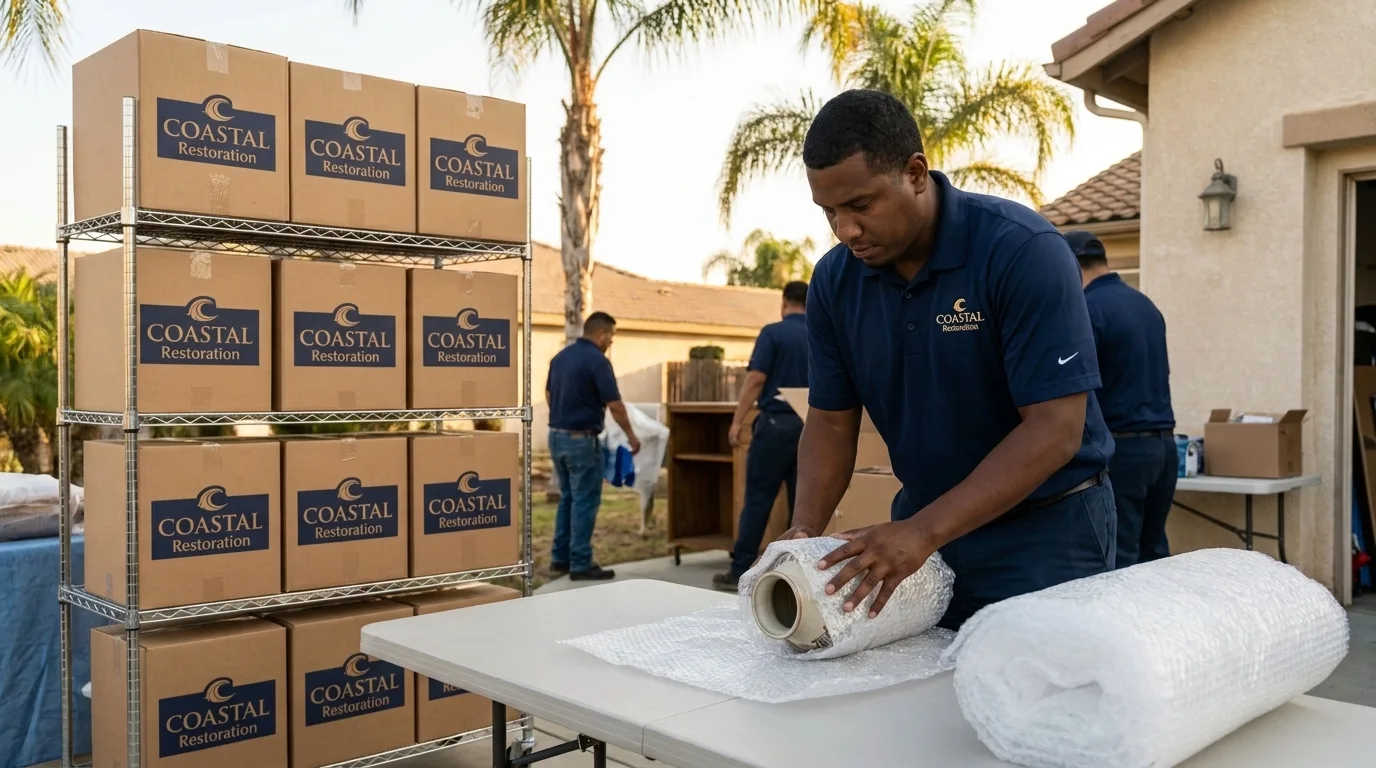
Contents Restoration and Storage in Vandenberg Village
Contents restoration and storage in Vandenberg Village and surrounding areas. Insurance billing accepted. Call (805) 345-7440.
After a fire, flood, or mold event, the structure gets most of the attention, but it’s often your furniture, clothing, documents, and keepsakes that carry the most loss. Smoke odor embeds itself into upholstery fibers within hours. Soot leaves a greasy film on electronics and artwork that hardens if it sits. Standing water warps wood furniture and saturates mattresses faster than most people realize. Contents restoration and storage is the discipline that treats your belongings as a separate, parallel workstream from the building itself, because they usually need different techniques, different timelines, and a secure place to go while the structure is being dried or rebuilt.
What Contents Restoration and Storage actually involves
Contents restoration is not hauling things to a warehouse and wiping them down. It begins with a room-by-room inventory, every item photographed, catalogued, and assigned a condition code before anything is moved. That documentation is the foundation of your insurance claim and the chain of custody for every item that leaves your property.
From there, items are sorted into three streams: items that can be restored on-site, items that need to be packed out to a climate-controlled facility for deeper cleaning or deodorization, and items that are beyond economical repair and need to be documented for replacement value. That last category matters enormously for insurance purposes, a written scope with photos and replacement costs is far more defensible than a verbal estimate.
The cleaning methods vary by material and contaminant. Ultrasonic cleaning tanks use high-frequency sound waves to remove soot and residue from hard goods, electronics, dishware, tools, decorative items, without abrasion. Soft goods like clothing, bedding, and drapes typically go through ozone or hydroxyl treatment for odor neutralization, followed by professional laundering. Documents and photographs can sometimes be freeze-dried to halt further deterioration. Furniture restoration after fire or water damage may involve refinishing, re-upholstering, or structural repair depending on the piece.
Storage, when needed, means a secure, climate-controlled facility, not a shipping container in a parking lot. Humidity and temperature swings will continue damaging items in transit or storage if conditions aren’t controlled.
Our process
-
On-site inventory and condition assessment. Before a single item is moved, every room is documented with photos and a written inventory. Items are tagged and assigned condition codes (restorable, questionable, total loss). This protects you and creates the adjuster-ready documentation your claim depends on.
-
Pack-out and secure transport. Restorable and questionable items are carefully packed using appropriate materials, fragile items wrapped and boxed, soft goods bagged and labeled, then transported to a climate-controlled storage and cleaning facility. The chain of custody is maintained throughout.
-
Cleaning and restoration by material type. Hard goods go through ultrasonic cleaning or hand cleaning depending on fragility. Soft goods are treated for odor using ozone or hydroxyl generators, then laundered. Electronics are assessed for function and cleaned by technicians familiar with moisture and soot damage. Furniture restoration after fire or water damage is scoped individually.
-
Deodorization and quality check. Odor is one of the most persistent problems in contents restoration, smoke and mold odors can re-emerge weeks later if treatment was surface-only. Items are checked after treatment and before return delivery to confirm odor neutralization held.
-
Return delivery and placement. Once the structure has been cleared and reconstruction is complete, items are returned, unwrapped, and placed. A final walkthrough confirms every inventoried item is accounted for.
What separates a good contents response from a bad one
The most common failure in contents restoration is skipping or rushing the inventory. Without a complete, itemized record taken before pack-out, there is no reliable way to reconcile what left the property with what came back, and no documentation to support replacement claims for items that couldn’t be saved. Insurance adjusters specifically look for photographic evidence of condition at the time of loss, not after cleaning attempts.
The second common failure is treating all soot the same. Protein soot from kitchen fires and synthetic soot from burning plastics or upholstery require different cleaning chemistry. Applying the wrong solvent can permanently set a stain or damage a finish. Experienced contents technicians characterize the soot type before choosing a cleaning method.
A third issue is inadequate deodorization. Ozone treatment is effective but requires proper dwell time and concentration, shortcuts produce items that smell clean in the facility and revert once back in a warm room. Hydroxyl generators are slower but can run around items and occupants safely. The right choice depends on the material and the severity of the odor.
Finally, soft goods that were wet, even briefly, need to be assessed for mold colonization before storage. Packing damp fabric into sealed bags or boxes accelerates mold growth and can contaminate other items in the same shipment.
What does Contents Restoration and Storage cost?
Typical costs for contents restoration and storage vary significantly based on the volume of items, the type of damage, and the cleaning methods required. Most homeowners pay somewhere in the ranges below for industry-typical scenarios, these are general figures, not quotes.
| Scenario | Typical range |
|---|---|
| Single room, light smoke or water, pack-out and return | $1,500 – $4,000 |
| Whole-house pack-out, moderate fire or water damage | $8,000 – $20,000 |
| Ultrasonic cleaning for hard goods (per load) | $300 – $800 |
| Soft goods laundering and deodorization (per bag) | $150 – $400 |
| Document or photo drying and recovery | $500 – $3,500 |
| Extended climate-controlled storage (per month) | $200 – $600 |
Every loss is different, and Coastal Restoration Services Inc provides a written scope of work before any contents restoration begins. Homeowners insurance typically covers contents restoration and storage when the loss is caused by a covered peril, fire, smoke, and sudden water damage are the most common, and the documentation generated during pack-out is exactly what carriers require to process those claims.
Seasonal and regional considerations
Vandenberg Village and the surrounding Santa Barbara County coastal corridor sit in a climate that feels mild but creates specific contents risks. The marine layer keeps indoor humidity elevated through much of the year, which means items that absorbed moisture during a water loss, upholstered furniture, wood pieces, paper goods, are slower to off-gas and more susceptible to secondary mold growth than they would be in a drier inland climate. Items stored improperly after a loss, even briefly, can develop mold colonies within 48 to 72 hours under these conditions.
During the dry season, when Santa Ana wind events push through, fire risk increases and so does the likelihood of smoke and soot damage to contents in homes near wildland-urban interface areas. Soot from vegetation fires has different characteristics than structural fire soot and can travel significant distances, affecting homes that weren’t directly involved in a fire.
Service area
Coastal Restoration Services Inc is based in Vandenberg Village and provides contents restoration and storage services throughout the surrounding region, including Lompoc, Santa Maria, Orcutt, Buellton, Solvang, and other communities in Santa Barbara County. The city-specific pages for each area link back here for the full service description.
If you’re trying to figure out what can be saved from a fire, flood, or mold event, and what the process actually looks like, call (805) 345-7440 to start a contents inventory and pack-out assessment.
Frequently Asked Questions
Does homeowners insurance cover contents restoration and storage?
What is a contents pack-out, and do I actually need one?
How do you handle electronics that were exposed to smoke or water?
Can smoke odor really be fully removed from furniture and clothing, or will it come back?
How do you document items for an insurance claim, and what happens to things that can't be saved?
Looking for the best contents restoration and storage company in Santa Maria?
Coastal Restoration Services Inc provides licensed and insured contents restoration and storage in Santa Maria, CA and the surrounding area. Customers rate us 5.0 out of 5 stars across 29 Google reviews. We answer calls 24/7 — call (805) 345-7440 for immediate help.
Need Contents Restoration and Storage now?
We respond 24/7 across Santa Maria and surrounding CA cities.
Related Coverage
- Our Restoration Services
- Contact Coastal Restoration Services Inc
- Contents Restoration and Storage in Arroyo Grande
- Contents Restoration and Storage in Atascadero
- Contents Restoration and Storage in Avila Beach
- Contents Restoration and Storage in Ballard
- Contents Restoration and Storage in Blacklake
- Contents Restoration and Storage in Buellton
- Contents Restoration and Storage in Callender
- Contents Restoration and Storage in Cambria
- Contents Restoration and Storage in Edna
- Contents Restoration and Storage in El Paso de Robles
- Contents Restoration and Storage in Grover Beach
- Contents Restoration and Storage in Guadalupe