
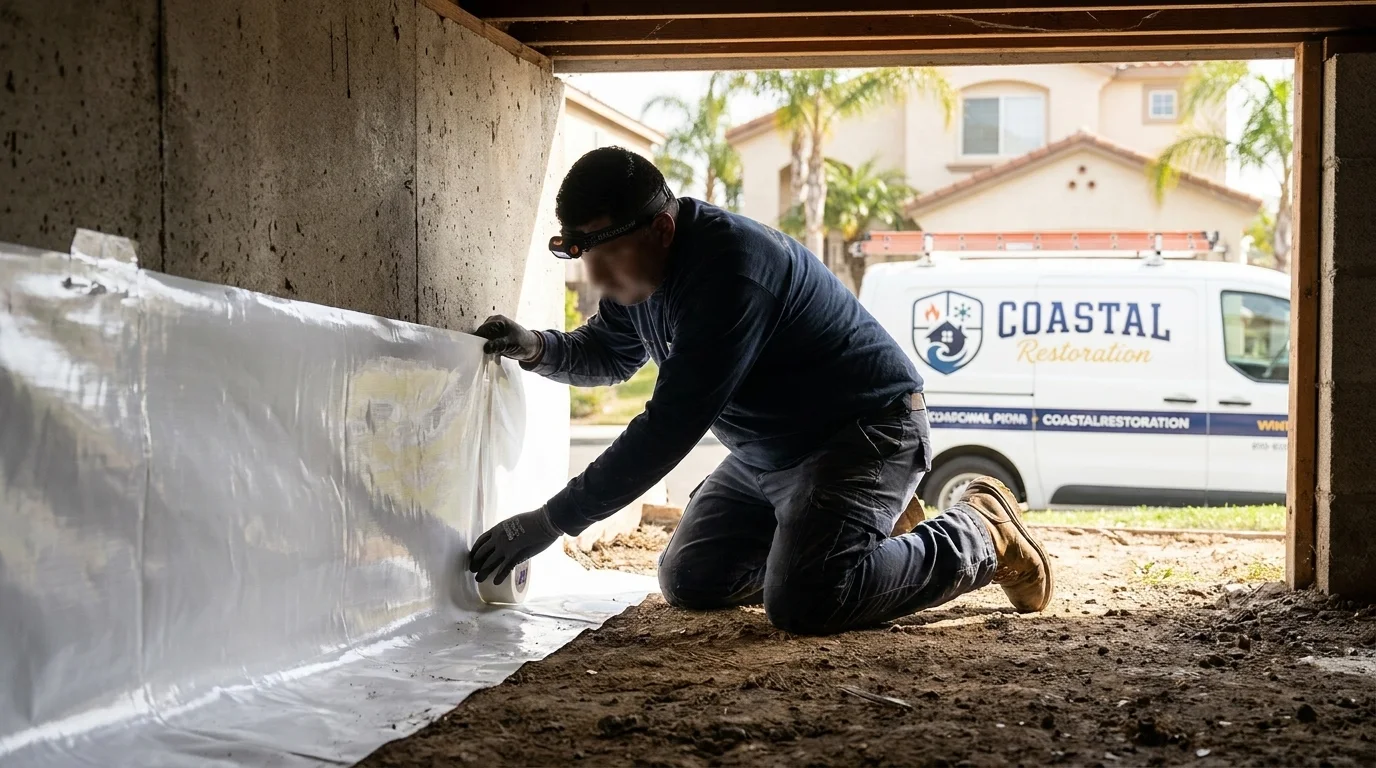
Crawl Space Encapsulation in Vandenberg Village
Crawl space encapsulation in Vandenberg Village, CA. Insurance billing accepted. Call (805) 345-7440.
Our IICRC-certified technicians are dispatched from our Santa Maria, CA headquarters and are typically on-site in Vandenberg Village within 60 minutes of your call.
Vandenberg Village sits just outside the main gate of Vandenberg Space Force Base on California’s Central Coast, where marine air rolls in off the Pacific nearly every afternoon and nighttime temperatures drop sharply even in summer. That combination, persistent coastal humidity, sandy loam soils that drain unevenly, and a housing stock built largely during the base-adjacent boom of the 1960s and 70s, creates crawl space conditions that can quietly deteriorate for years before a homeowner notices the musty smell in the living room or the soft spot developing in the subfloor. Coastal Restoration Services Inc is based here in Vandenberg Village and handles crawl space encapsulation for exactly these homes.
Why Vandenberg Village Properties Are Prone to Crawl Space Moisture Problems
The Central Coast marine layer is relentless from roughly May through September. Ground-level relative humidity in this area regularly climbs above 80 percent overnight, and the sandy, decomposed-granite soils common throughout the Lompoc Valley don’t hold a consistent moisture barrier on their own. Older crawl spaces in this community were typically built with thin poly sheeting, or none at all, and passive foundation vents that were designed for a drier inland climate standard. When cool, humid Pacific air cycles through those vents at night and meets the warmer soil surface, condensation forms on floor joists, vapor barriers, and HVAC ductwork running through the crawl.
Homes built in the 1960s through the early 1980s, which make up a large portion of the residential stock in Vandenberg Village, frequently used untreated wood framing in the crawl space. After decades of seasonal humidity swings, that wood is often showing early-stage fungal growth or wood rot even when there has never been a plumbing leak. A full encapsulation system addresses the root cause rather than treating the symptom.
Our Crawl Space Encapsulation Process in Vandenberg Village
Every encapsulation project starts with a thorough crawl space inspection, measuring moisture levels in the soil and wood framing, checking for standing water or drainage issues, and documenting any existing vapor barrier, insulation, or pest activity. In this area, we pay particular attention to HVAC ductwork that passes through the crawl, because condensation on uninsulated flex duct is one of the most common, and most overlooked, moisture sources in local homes.
Once the inspection is complete, the process moves through these stages:
- Debris and old vapor barrier removal, deteriorated poly sheeting, insulation batts that have fallen from the joists, and any organic debris are removed and disposed of properly.
- Drainage and grading correction, if low spots in the crawl are pooling water, we address grade or install a perimeter drain channel before sealing anything in.
- 20-mil reinforced encapsulation membrane, a heavy-duty, puncture-resistant liner is sealed to the foundation walls and piers, eliminating ground moisture vapor at the source.
- Rim joist insulation and air sealing, the band joist is one of the biggest thermal and moisture bridges in a crawl space; we insulate and seal it with closed-cell spray foam or rigid board.
- Conditioned air or dehumidification, depending on the home’s HVAC configuration, we either condition the crawl space with a supply duct or install a dedicated crawl space dehumidifier sized for the square footage.
The result is a crawl space that stays dry, reduces HVAC load, and protects the structural framing from the humidity cycles that are simply part of living on California’s Central Coast.
What Makes Encapsulation Different Here vs. Inland California
Contractors who primarily work in the Inland Empire or the Central Valley are used to crawl spaces where the main threat is summer heat and occasional rain intrusion. In Vandenberg Village, the moisture threat is year-round and comes primarily from the air, not from rain events. That changes the encapsulation design. A system that relies heavily on passive venting, which is still code-compliant in some California jurisdictions under certain conditions, will underperform here because the outside air being vented in is often more humid than the crawl space itself during summer nights.
For homes in this area, we typically recommend a sealed, conditioned crawl space rather than a vented one, and we size dehumidification equipment based on the specific square footage and soil conditions rather than using a one-size-fits-all unit.
Local Note
Homes in Vandenberg Village that were originally built as military family housing or converted from base-adjacent contractor developments often have non-standard crawl space access hatches, sometimes located inside closets, under bathroom vanities, or in garages rather than on the exterior foundation. Before scheduling work, it’s worth confirming access location with us over the phone, because tight interior access points can affect equipment staging and add time to the job. We’ve worked in enough of these homes to come prepared, but a quick heads-up saves everyone time on the first day.
Call Coastal Restoration Services Inc at (805) 345-7440 to schedule a crawl space inspection in Vandenberg Village. We’ll give you a clear picture of what’s happening under your home and a straightforward recommendation, whether that’s a full encapsulation system or a more targeted repair, so you can make an informed decision before the next marine layer season sets in.
Serving Vandenberg Village from our Santa Maria headquarters — ★ 5.0 · 29 Google reviews
“Speedy work and very well done. Flexible with scheduling days and left very happy with the service. Recommend.” — Alejandra, July 2026Read our reviews on Google →
Crawl Space Encapsulation in Vandenberg Village: Service Coverage
Frequently Asked Questions
How fast can you arrive for crawl space encapsulation in Vandenberg Village?
Why are crawl spaces in Vandenberg Village more prone to moisture problems than homes further inland?
My Vandenberg Village home was built in the 1970s — is the existing vapor barrier worth keeping, or does it need to be replaced?
Does crawl space encapsulation in Vandenberg Village require a permit, and will it affect my home's foundation vents?
How long does a crawl space encapsulation project typically take for a single-family home in Vandenberg Village?
Can crawl space encapsulation in Vandenberg Village help with high energy bills or HVAC performance?
Will my homeowners insurance cover crawl space encapsulation in Vandenberg Village?
Crawl Space Encapsulation response in Vandenberg Village
Most Vandenberg Village calls see a technician on-site within 60 minutes from our Santa Maria headquarters.