
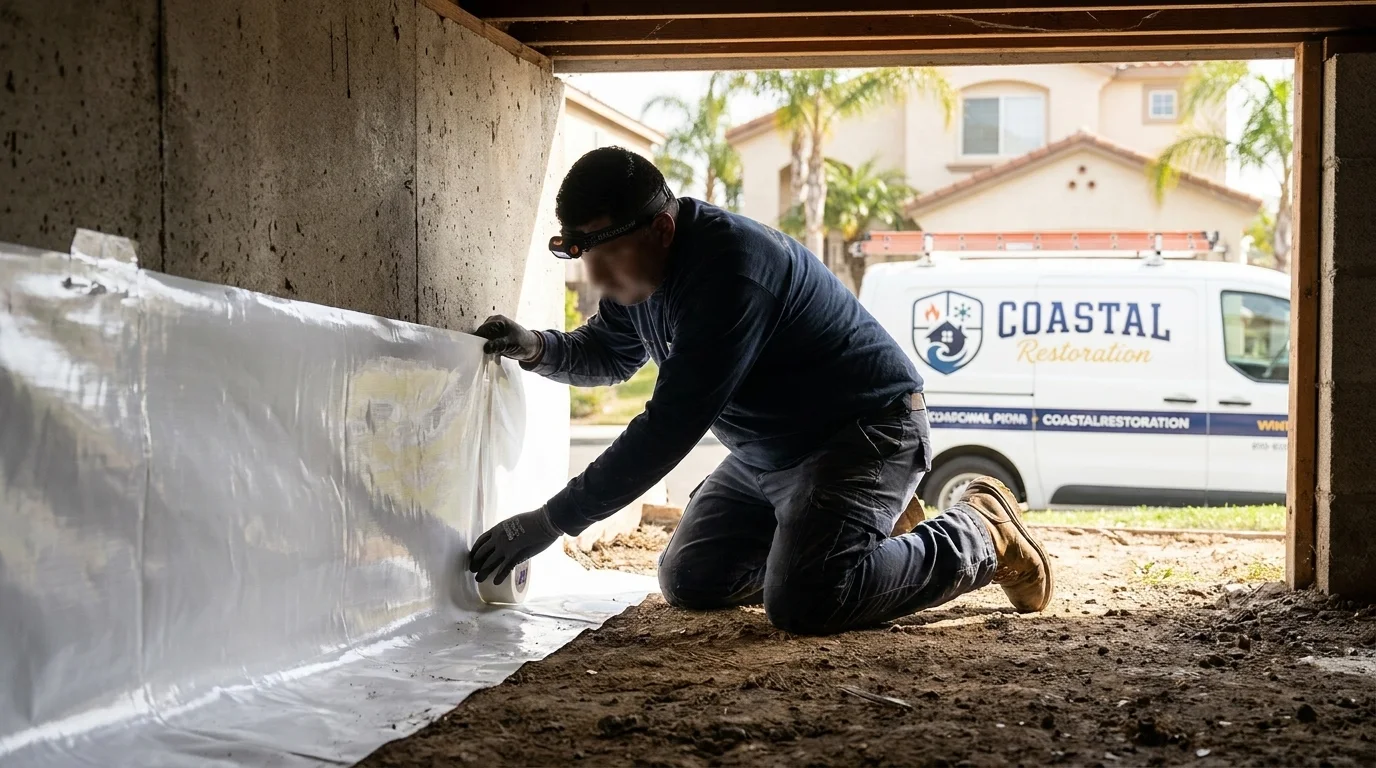
Crawl Space Encapsulation in Santa Ynez
Crawl space encapsulation in Santa Ynez, CA. Insurance billing accepted. Call (805) 345-7440.
Our IICRC-certified technicians are dispatched from our Santa Maria, CA headquarters and are typically on-site in Santa Ynez within 60 minutes of your call.
Santa Ynez sits in a valley where warm, dry summers and cool, fog-laced winters create a moisture cycle that most homeowners never think about until they smell it, that damp, earthy odor rising through the floorboards of an older ranch-style home after the first significant rain of the season. Crawl spaces in this part of Santa Barbara County are particularly vulnerable because the valley’s clay-heavy soils retain groundwater long after surface conditions look dry, keeping the underside of your home in contact with elevated humidity for weeks at a time.
Why Santa Ynez Properties See Crawl Space Problems
The Santa Ynez Valley’s Mediterranean climate is beautiful for wine grapes and brutal on unprotected crawl spaces. Winter rainfall, typically concentrated between November and March, saturates the ground quickly, and the valley floor’s low permeability means water has nowhere fast to go. Vented crawl spaces, which are common in the region’s post-WWII and mid-century ranch homes, pull that moisture-laden air directly under your living space. Within 48 to 72 hours of standing moisture, wood framing can begin to support mold colonization. Over a full season, floor joists soften, insulation sags and loses R-value, and pest activity increases, rodents and subterranean termites are both attracted to damp wood.
Santa Ynez also experiences temperature swings that are sharper than coastal communities just over the San Marcos Pass. Nights can drop into the low 40s while afternoons push into the 80s, even in shoulder seasons. That daily thermal cycling causes condensation to form repeatedly on cold crawl space surfaces, compounding the moisture load even in dry weather.
Our Crawl Space Encapsulation Process in Santa Ynez
Encapsulation in this valley requires more than rolling out a sheet of plastic. The process begins with a thorough assessment of the crawl space, measuring humidity levels, inspecting wood moisture content with a calibrated meter, and identifying any active water intrusion points or compromised vapor barriers from previous attempts.
Once the space is prepared (existing debris removed, standing water extracted if present, damaged insulation pulled), we install a heavy-duty reinforced polyethylene liner, typically 20-mil thickness, across the entire floor and up the foundation walls, sealed at seams with pressure-sensitive tape and mechanically fastened at the perimeter. For Santa Ynez homes where the soil is particularly damp or where the crawl space is deeper than average, we often recommend pairing the liner with a crawl space dehumidifier sized to the cubic footage of the space. This keeps relative humidity below 60% year-round, the threshold above which mold and wood rot accelerate.
Vents are sealed as part of a conditioned crawl space system, counterintuitive to many homeowners, but building science research and California’s Title 24 energy code both support this approach in climates like Santa Ynez’s, where outdoor air is frequently more humid than a properly sealed interior.
Equipment and Methods for Santa Ynez Conditions
The clay soils common to the valley floor can hold moisture against a liner, so we pay close attention to sub-liner drainage. In crawl spaces where water has historically pooled, a perforated drain pipe running to a sump pit or daylight outlet is installed before the liner goes down. This prevents hydrostatic pressure from lifting or buckling the encapsulation material over time.
For the liner itself, we use products rated for ground contact with reinforced scrim cores, not the thin sheeting sold at hardware stores, which tears during routine access and degrades within a few years. Access hatches and any HVAC equipment in the crawl space are carefully worked around so the system remains serviceable without compromising the seal.
Reaching Santa Ynez from Vandenberg Village
Coastal Restoration Services Inc is based in Vandenberg Village, and Santa Ynez is a straightforward drive east via Highway 246 through Lompoc and Buellton. The route is direct, and the team is familiar with the valley’s geography from Buellton to the eastern end of the Santa Ynez Valley. When you call (805) 345-7440, the team can confirm scheduling and give you a realistic arrival window based on current workload.
Local Note
One thing that comes up repeatedly on Santa Ynez properties, particularly on the older agricultural parcels and equestrian estates that make up a significant share of the housing stock here, is that crawl spaces were sometimes backfilled with decomposed granite or loose gravel rather than left as native soil. That material drains better than clay, but it also means the vapor barrier installation requires more careful anchoring because the surface is uneven and friable. A liner that looks flat on day one can shift and gap at seams within a season if it isn’t properly weighted and fastened at the edges. It’s a detail that matters in this valley in a way it simply doesn’t in a tract home on a flat concrete stem wall.
If your Santa Ynez home has a crawl space that smells musty after rain, shows signs of sagging insulation, or has never had a proper vapor barrier installed, encapsulation is one of the highest-return improvements you can make to the long-term health of the structure. Call Coastal Restoration Services Inc at (805) 345-7440 to schedule an assessment, the conversation is straightforward, and the inspection will tell you exactly what the space needs.
Serving Santa Ynez from our Santa Maria headquarters — ★ 5.0 · 29 Google reviews
“Gave them a call and they came out right away! The crew was professional, courteous, and respectful. We would highly recommend them to anyone in the area.” — Jesus, July 2026Read our reviews on Google →
Crawl Space Encapsulation in Santa Ynez: Service Coverage
Frequently Asked Questions
How fast can you arrive for crawl space encapsulation in Santa Ynez?
Is crawl space encapsulation worth it for a Santa Ynez home that only gets wet a few months a year?
Does Santa Barbara County have any permit requirements for crawl space encapsulation work?
How does the clay soil in the Santa Ynez Valley affect how long encapsulation takes?
What liner thickness do you use, and why does it matter in Santa Ynez specifically?
Can crawl space encapsulation help with the musty smell that comes up through the floors of older Santa Ynez homes after rain?
Will my homeowners insurance cover crawl space encapsulation in Santa Ynez?
Crawl Space Encapsulation response in Santa Ynez
Most Santa Ynez calls see a technician on-site within 60 minutes from our Santa Maria headquarters.