
Crawl Space Encapsulation in Nipomo
Crawl space encapsulation in Nipomo, CA. Insurance billing accepted. Call (805) 345-7440.
Our IICRC-certified technicians are dispatched from our Santa Maria, CA headquarters and are typically on-site in Nipomo within 60 minutes of your call.
Nipomo sits in a coastal transition zone where marine air from the Pacific pushes inland through the Santa Maria Valley, keeping relative humidity elevated even on days that feel dry. That persistent moisture, combined with the sandy, loosely compacted soils common across much of San Luis Obispo County’s southern edge, creates crawl space conditions that quietly work against a home’s structure year-round. Vapor migrates up through bare ground, condenses on wood framing, and sets the stage for rot, pest intrusion, and air quality problems that eventually make their way into the living space above.
Why Nipomo Homes Are Particularly Vulnerable to Crawl Space Moisture
Nipomo’s position between the coast and the inland valleys means it catches marine layer influence without the salt-air buffering that oceanfront communities experience. Summer mornings regularly bring low clouds and high relative humidity before the afternoon sun burns them off, but by then, the crawl space has already absorbed hours of moisture-laden air. Homes built on the mesa areas of Nipomo often have shallow crawl spaces over sandy fill, which drains quickly after rain but allows ground-level vapor to rise freely when temperatures fluctuate.
Older homes in the area, many built during the agricultural expansion of the 1960s and 1970s, were constructed with vented crawl spaces that met code at the time. That design made sense in drier inland climates, but in Nipomo’s microclimate, passive venting can actually draw in more humid air than it expels. The result is wood subfloor framing that stays damp long enough to support fungal growth, and insulation that loses its R-value as it absorbs moisture and eventually falls away from the joists.
Our Crawl Space Encapsulation Process in Nipomo
Encapsulation in Nipomo isn’t a one-size installation. Before any material goes down, a technician does a thorough crawl space inspection, checking for standing water, existing vapor barrier remnants, pest evidence, and the condition of wood framing and insulation. In Nipomo’s sandy-soil areas, we pay particular attention to how ground moisture is moving, since vapor transmission rates vary significantly depending on whether the subgrade is native soil, compacted fill, or disturbed construction debris.
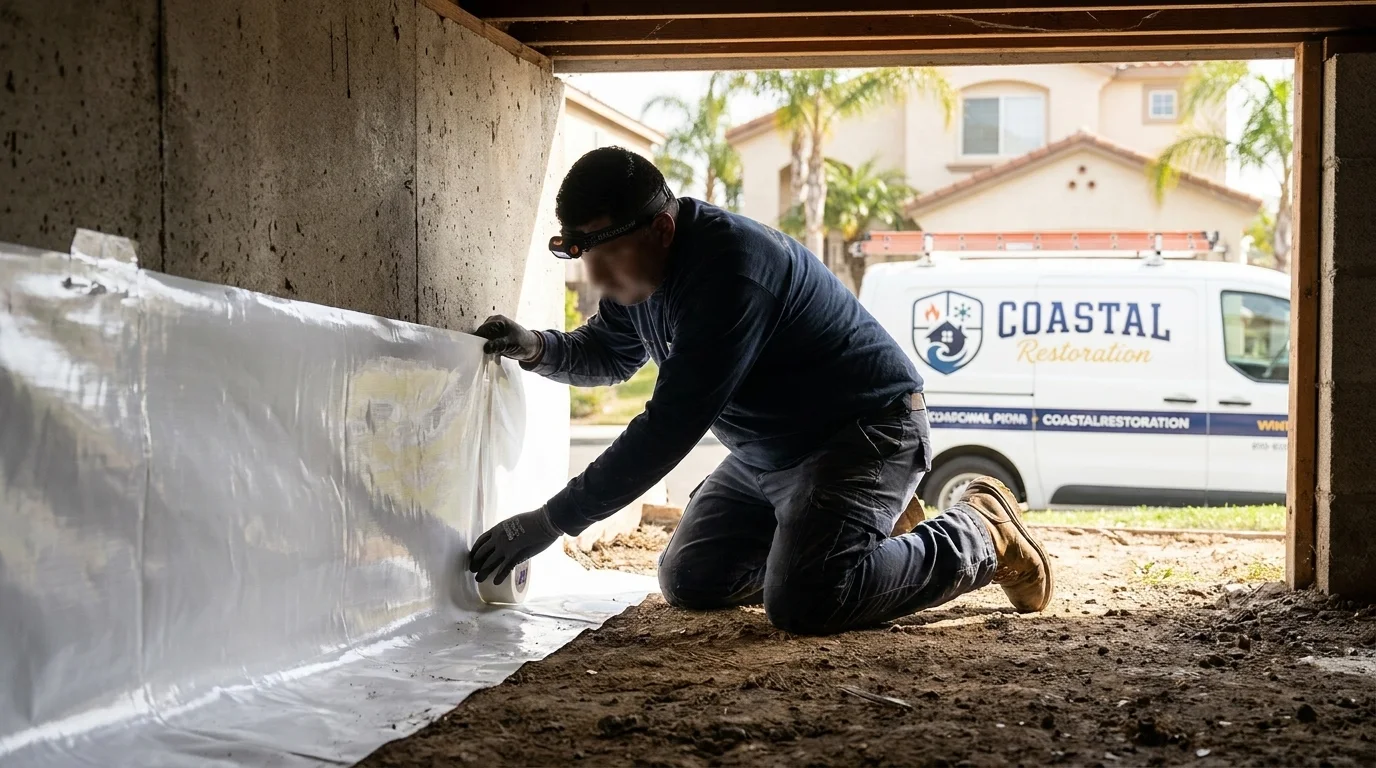
Once the space is cleared and any damaged insulation or debris is removed, we install a heavy-duty reinforced polyethylene liner, typically 20-mil, across the entire ground surface and up the foundation walls, sealed at all seams and penetrations. Unlike a thin sheeting product stapled loosely to the ground, a properly sealed liner turns the crawl space into a semi-conditioned buffer zone that breaks the moisture pathway between the soil and your floor system.
Depending on the home’s layout and existing HVAC configuration, we assess whether a crawl space dehumidifier or a connection to the home’s conditioned air supply is appropriate to maintain the space at a stable humidity level year-round. In Nipomo’s climate, passive encapsulation alone is often sufficient during drier months, but the marine influence during late fall and winter typically warrants active humidity control for long-term performance.
Equipment and Methods We Use for Crawl Space Encapsulation
The liner material matters more than most homeowners realize. Thin poly sheeting, the kind sold at hardware stores, tears easily, allows vapor transmission over time, and doesn’t seal reliably around piers, pipes, and other penetrations. We use reinforced liners rated for long-term ground contact, with taped and mastic-sealed seams at every overlap and transition. Foundation wall coverage is secured with mechanical fasteners and sealant rather than relying on adhesive alone, which can fail in the temperature swings Nipomo sees between summer afternoons and cool coastal nights.
For homes where existing wood framing shows early signs of moisture damage, surface mold, soft spots, or discoloration, we address that before encapsulation so the liner isn’t trapping a problem rather than preventing one. Any remediation work is done to industry-standard drying and treatment protocols before the encapsulation installation closes off access.
Local Note
One thing that comes up regularly on Nipomo jobs: homes built in the 1970s and early 1980s on the west side of town often have crawl space access hatches that are interior, cut into a closet floor or a utility room, rather than through an exterior foundation vent. That matters for equipment staging and debris removal, since everything has to come through the living space. We flag this during the initial inspection and lay down floor protection before work begins, so the encapsulation project doesn’t leave a trail through the house.
If you’re dealing with musty odors coming through your floors, insulation that’s dropped from the joists, or a pest control company that keeps finding evidence of moisture in the crawl space, the underlying problem is usually vapor, and encapsulation is the fix that addresses it at the source. Call Coastal Restoration Services Inc at (805) 345-7440 to schedule an inspection for your Nipomo home.
Serving Nipomo from our Santa Maria headquarters — ★ 5.0 · 29 Google reviews
“Speedy work and very well done. Flexible with scheduling days and left very happy with the service. Recommend.” — Alejandra, July 2026Read our reviews on Google →
Crawl Space Encapsulation in Nipomo: Service Coverage
Frequently Asked Questions
How fast can you arrive for crawl space encapsulation in Nipomo?
How does Nipomo's marine layer climate affect how long a crawl space encapsulation lasts?
Are homes on Nipomo's mesa areas more prone to crawl space moisture problems than other parts of town?
Does Nipomo's building stock — a lot of homes from the 1960s and 1970s — require any special steps before encapsulation?
What liner thickness do you use, and does it matter for a Nipomo crawl space?
Will crawl space encapsulation help with the musty smell coming up through the floors in my Nipomo home?
Will my homeowners insurance cover crawl space encapsulation in Nipomo?
Crawl Space Encapsulation response in Nipomo
Most Nipomo calls see a technician on-site within 60 minutes from our Santa Maria headquarters.