
Crawl Space Encapsulation in Lompoc
Crawl space encapsulation in Lompoc, CA. Insurance billing accepted. Call (805) 345-7440.
Our IICRC-certified technicians are dispatched from our Santa Maria, CA headquarters and are typically on-site in Lompoc within 60 minutes of your call.
Lompoc sits in a coastal valley where marine air from the Pacific funnels inland through the Santa Ynez River corridor, keeping relative humidity elevated even on sunny afternoons. That persistent moisture finds its way into unprotected crawl spaces, where bare soil and inadequate venting create the exact conditions that accelerate wood rot, attract termites, and allow mold to colonize floor joists within weeks of a wet season. Crawl space encapsulation seals that environment off permanently, and in Lompoc’s climate, it’s less a luxury upgrade than a long-term structural investment.
Why Lompoc Properties Are Especially Vulnerable to Crawl Space Moisture
The Santa Ynez Valley’s geography means Lompoc receives coastal fog intrusion well into late morning for much of the year. Underneath homes, that translates to ground-level relative humidity that can hover above 70% even when the surface soil looks dry. Older homes throughout the city, many built in the postwar boom years when vapor barriers weren’t standard practice, sit over bare dirt crawl spaces with minimal cross-ventilation. Ground moisture evaporates upward, condenses on cold floor framing, and slowly degrades the wood from below.
Beyond humidity, Lompoc’s soil composition in lower-lying areas near the river plain tends toward clay-heavy profiles that retain water long after rain events. Clay soil doesn’t drain quickly, so crawl spaces in those zones stay damp for weeks after a storm. Homeowners often don’t notice the problem until they smell mustiness through the subfloor or feel soft spots in hardwood floors, both signs that moisture has already been working on the structure for months.
Our Crawl Space Encapsulation Process in Lompoc
Every encapsulation project starts with a thorough inspection of the crawl space, measuring moisture levels in the framing, checking existing vents, and identifying any standing water or active drainage issues. In Lompoc, that inspection step often turns up deteriorated fiberglass batt insulation hanging between joists, which holds moisture like a sponge and needs to be removed before any barrier goes down.
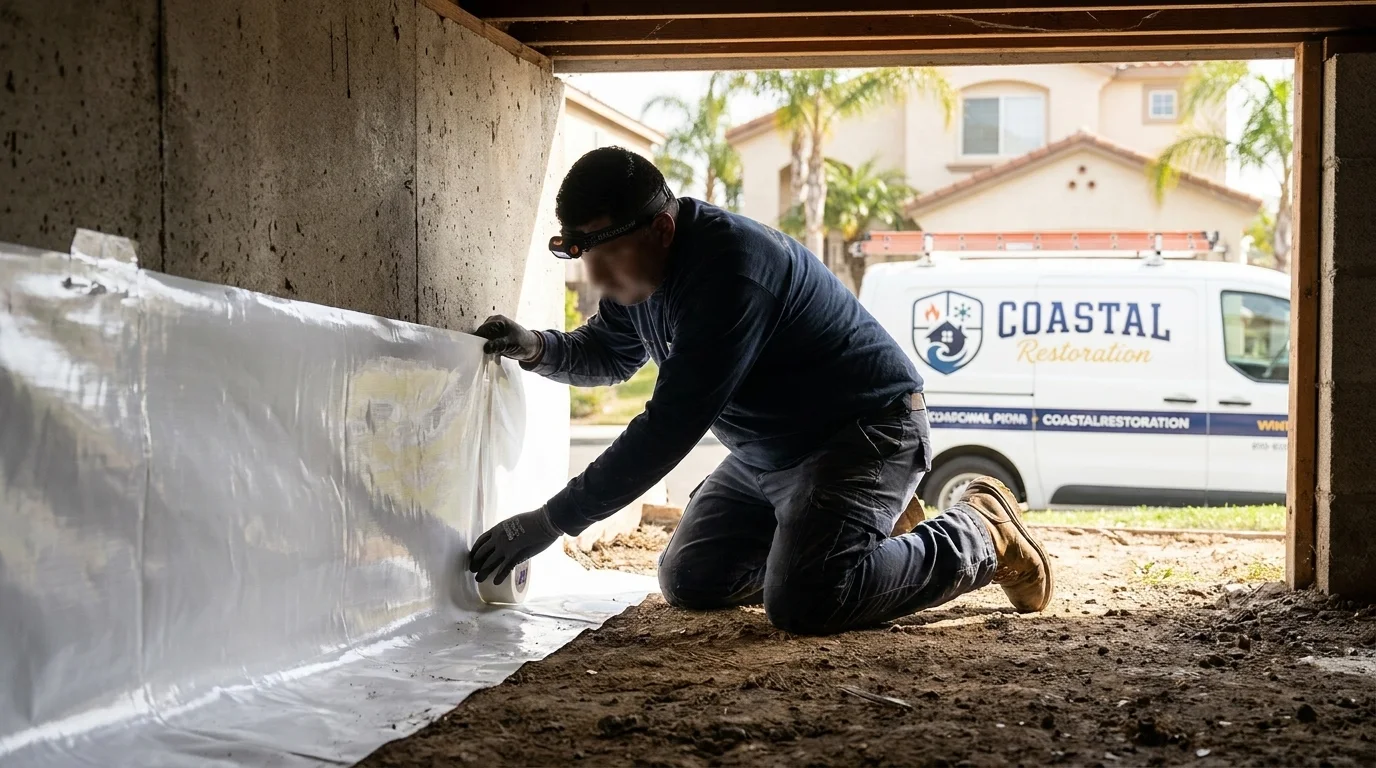
Once the space is cleared and dried, we install a heavy-duty polyethylene vapor barrier, typically 20-mil reinforced material, across the entire ground surface and up the foundation walls, sealed at seams and penetrations with moisture-resistant tape. Depending on the crawl space’s natural airflow, we may also recommend closing off existing foundation vents and adding a mechanical dehumidifier to maintain the sealed environment year-round. In Lompoc’s climate, a sealed and conditioned crawl space consistently outperforms a vented one because the marine air coming through open vents introduces more humidity than it removes during the cooler months.
The process typically takes one to two days for a standard single-family home, and the difference in subfloor humidity is measurable within the first week.
Equipment and Methods We Use for Crawl Space Encapsulation
The barrier material matters more than most homeowners realize. Thin 6-mil sheeting, still sold at big-box stores, punctures easily during routine crawl space access and degrades within a few years under the alkaline conditions common in Central Coast soils. The reinforced 20-mil liner we use is rated for foot traffic and resists tearing at penetration points like plumbing cleanouts and HVAC supports.
For homes where existing moisture has already reached the framing, we bring in commercial-grade desiccant dehumidifiers and air movers to dry the structural wood to below 19% moisture content before sealing, the threshold at which wood-destroying fungi cannot sustain growth. We measure with calibrated pin-type moisture meters at multiple joist locations, not just at the access hatch, so the reading reflects conditions throughout the space rather than just the easiest spot to reach.
Local Note
One thing we’ve learned working throughout the Lompoc area: homes in the lower sections of the city near the river plain sometimes have crawl space access hatches that open directly against the foundation stem wall, leaving less than 18 inches of clearance for the first several feet inside. Tight-access encapsulation requires smaller equipment staging and more hand-work on barrier installation, it takes longer, but skipping those hard-to-reach corners is exactly where moisture problems restart. We account for access difficulty in every estimate rather than quoting a flat rate and adjusting later.
If you’re noticing musty odors, higher-than-normal heating bills, or soft spots in your flooring, the crawl space is often the first place to look. Coastal Restoration Services Inc serves Lompoc and the surrounding Santa Barbara County communities from our base in Vandenberg Village, call (805) 345-7440 to schedule an on-site crawl space assessment and get a clear picture of what’s happening beneath your home before the next wet season arrives.
Serving Lompoc from our Santa Maria headquarters — ★ 5.0 · 29 Google reviews
“Yes i highly recommend. Coastal rushed to the scene on the weekend and promptly provided valued feedback. We were able to move forward with our situation forthwith. Very satisfied with outcome.” — George, July 2026Read our reviews on Google →
Crawl Space Encapsulation in Lompoc: Service Coverage
Frequently Asked Questions
How fast can you arrive for crawl space encapsulation in Lompoc?
How does Lompoc's coastal fog pattern affect how long a crawl space encapsulation project takes?
Are homes near the Santa Ynez River corridor in Lompoc at higher risk for crawl space moisture problems?
Will Lompoc's older postwar housing stock require any special preparation before encapsulation?
What thickness of vapor barrier do you recommend for Lompoc's climate, and why does it matter?
How far is Coastal Restoration Services Inc from Lompoc, and how do you schedule service in the area?
Will my homeowners insurance cover crawl space encapsulation in Lompoc?
Crawl Space Encapsulation response in Lompoc
Most Lompoc calls see a technician on-site within 60 minutes from our Santa Maria headquarters.