
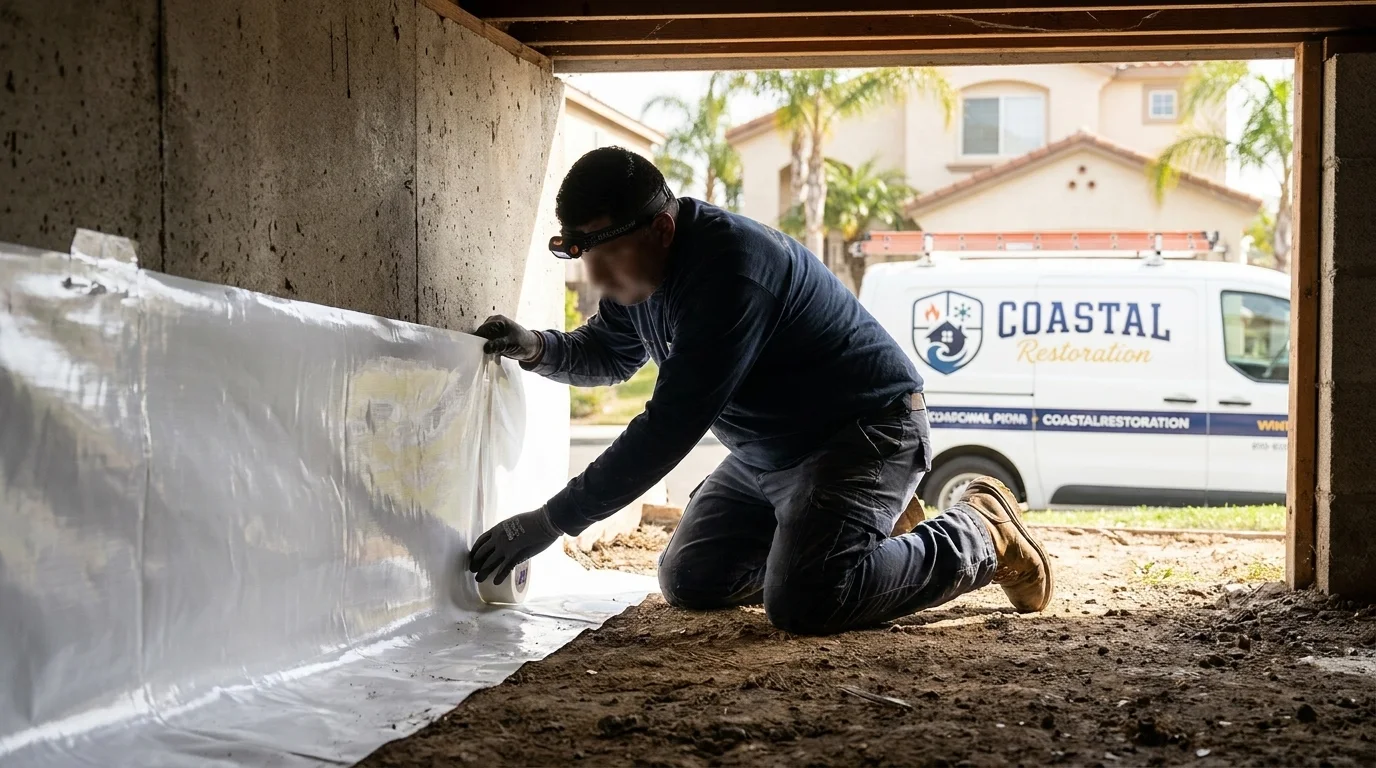
Crawl Space Encapsulation in Blacklake
Crawl space encapsulation in Blacklake, CA. Insurance billing accepted. Call (805) 345-7440.
Our IICRC-certified technicians are dispatched from our Santa Maria, CA headquarters and are typically on-site in Blacklake within 60 minutes of your call.
Blacklake sits in a stretch of coastal Santa Barbara County where marine air rolls inland with enough regularity that crawl spaces underneath older homes rarely get a chance to dry out between wet seasons. That persistent dampness, compounded by the region’s clay-heavy soils that hold moisture long after rain has stopped, creates exactly the conditions where vapor intrusion, wood rot, and mold colonization take hold quietly beneath your floors. Crawl space encapsulation addresses that problem at the source, sealing the ground and foundation walls before moisture ever reaches your subfloor framing.
Why Blacklake Properties Are Prone to Crawl Space Moisture Problems
The soils common to this part of San Luis Obispo and Santa Barbara County expand when wet and shrink when dry, a cycle that gradually works at foundation perimeters and creates small gaps where outside air, and the humidity it carries, migrates into crawl spaces. Homes built before modern vapor barrier requirements were standard often have bare dirt floors or thin, degraded poly sheeting that offers little real protection. When the Pacific fog season stretches from late spring through early fall, relative humidity in an unencapsulated crawl space can stay above 70% for weeks at a stretch. At that level, mold can begin colonizing wood framing within 24 to 48 hours of a moisture event, a burst supply line, a slow plumbing drip, or even a single heavy rain that overwhelms a clogged crawl space vent.
Older ranch-style construction common throughout this area of coastal California also tends to have shallow crawl spaces with limited clearance, which makes passive ventilation less effective and makes standing water harder to detect until the damage is already significant.
Our Crawl Space Encapsulation Process in Blacklake
Every encapsulation job starts with a thorough crawl space inspection, clearance measurements, moisture readings at multiple points across the floor and against foundation walls, and a check for any existing standing water, wood decay, or active mold growth. If remediation is needed before encapsulation, that work happens first; sealing a crawl space over an active mold problem only traps the issue.
Once the space is clean and dry, the process follows a deliberate sequence:
- Ground cover installation, A reinforced, puncture-resistant polyethylene barrier (typically 12 to 20 mil) is laid across the entire crawl space floor, overlapping seams by at least 12 inches and sealed with moisture-resistant tape.
- Wall lining, The same barrier material runs up foundation walls and is mechanically fastened and sealed at the top, closing off the primary pathway for soil vapor.
- Vent sealing, In a fully conditioned encapsulation, exterior foundation vents are sealed and the space is brought into the home’s conditioned envelope, eliminating the humid outside air exchange that drives moisture accumulation in coastal climates.
- Drainage and dehumidification, Where groundwater intrusion is a factor, a perimeter drain channel and sump system may be installed. A crawl space dehumidifier sized for the square footage maintains relative humidity below 55% year-round.
All work is calibrated to the specific clearance and soil conditions we find on-site, no two crawl spaces in this region are identical.
Equipment and Materials We Use
The barrier material matters more than most homeowners realize. Thin, single-ply poly degrades quickly in the temperature swings and occasional standing water common to California coastal crawl spaces. Coastal Restoration Services uses reinforced multi-ply barriers rated for long-term ground contact, with antimicrobial additives that inhibit mold growth on the liner itself. Dehumidifiers are commercial-grade, Energy Star–rated units with gravity or pump drainage, not the portable box-store units that require manual emptying and lack the capacity for a full crawl space environment.
For homes where the crawl space connects to an HVAC system, we verify that duct runs within the space are intact and insulated before closing out the job, since conditioned air leaking into an unencapsulated crawl space accelerates moisture cycling.
Local Note
One pattern that comes up repeatedly in this part of coastal California: homes that were re-plumbed or had irrigation lines added in the 1980s and 1990s sometimes have supply or drain lines running through the crawl space with no secondary containment. A slow drip from an elbow fitting can wet the soil for months before it shows up as a soft spot in the floor above. When we inspect crawl spaces in this area, we photograph every visible plumbing run and flag anything that looks like it has been weeping, not because plumbing repair is our scope, but because encapsulating over an active leak defeats the purpose entirely. It’s a step that takes an extra 20 minutes and has saved more than a few homeowners from a repeat call.
If you’re noticing musty odors when your HVAC kicks on, soft or springy spots in your floor, or visible efflorescence on your foundation walls, those are signals worth acting on before the next rainy season. Call Coastal Restoration Services Inc at (805) 345-7440 to schedule an inspection, we’ll tell you honestly what the crawl space needs and what it doesn’t.
Serving Blacklake from our Santa Maria headquarters — ★ 5.0 · 29 Google reviews
“Speedy work and very well done. Flexible with scheduling days and left very happy with the service. Recommend.” — Alejandra, July 2026Read our reviews on Google →
Crawl Space Encapsulation in Blacklake: Service Coverage
Frequently Asked Questions
How fast can you arrive for crawl space encapsulation in Blacklake?
How does Blacklake's coastal climate affect how long a crawl space encapsulation lasts?
Are homes in the Blacklake area more likely to need a sump pump added during encapsulation?
Does Blacklake's climate mean I should choose a fully conditioned encapsulation over a vented crawl space?
What does crawl space encapsulation typically cost for a home in the Blacklake area, and does homeowners insurance cover it?
How do you reach properties in the Blacklake area from your Vandenberg Village location, and how soon can I expect a crew on-site?
Crawl Space Encapsulation response in Blacklake
Most Blacklake calls see a technician on-site within 60 minutes from our Santa Maria headquarters.