
Crawl Space Encapsulation in Ballard
Crawl space encapsulation in Ballard, CA. Insurance billing accepted. Call (805) 345-7440.
Our IICRC-certified technicians are dispatched from our Santa Maria, CA headquarters and are typically on-site in Ballard within 60 minutes of your call.
Ballard, CA sits in a coastal climate corridor where marine air pushes persistent moisture inland year-round, and that moisture has nowhere to go except down. Crawl spaces beneath homes in this part of Santa Barbara County collect humidity the way a sponge collects water: slowly, invisibly, and with consequences that compound over months. By the time a homeowner notices musty odors drifting up through the floorboards or feels soft spots developing underfoot, the vapor intrusion has often been underway for a full season or more. Crawl space encapsulation stops that cycle by sealing the space from the ground up.
Why Ballard Properties Are Especially Vulnerable to Crawl Space Moisture
The coastal geography around Ballard creates conditions that are genuinely harder on crawl spaces than drier inland climates. Relative humidity regularly climbs above 80 percent during the marine layer season, and that ambient moisture migrates directly into unencapsulated crawl spaces through bare dirt floors and unsealed foundation vents. The result is a microenvironment that stays damp even when the weather above ground feels mild.
Homes in this part of California were often built on pier-and-beam or shallow perimeter foundations that leave substantial air volume beneath the subfloor, more surface area for moisture to contact wood joists, insulation batts, and the underside of subflooring. When that wood stays above 19 percent moisture content for extended periods, structural softening and mold colonization become realistic outcomes, not hypothetical ones. The coastal soil profile here also tends toward clay-heavy compositions that hold water near the surface rather than draining it away, which keeps ground vapor pressure elevated long after rain events.
Our Crawl Space Encapsulation Process in Ballard
Every encapsulation project starts with a thorough crawl space inspection, measuring moisture levels in the framing, checking for existing mold growth, assessing insulation condition, and identifying any standing water or drainage issues that need to be resolved before sealing begins. Skipping that diagnostic step and laying liner over a wet or compromised space just traps problems inside.
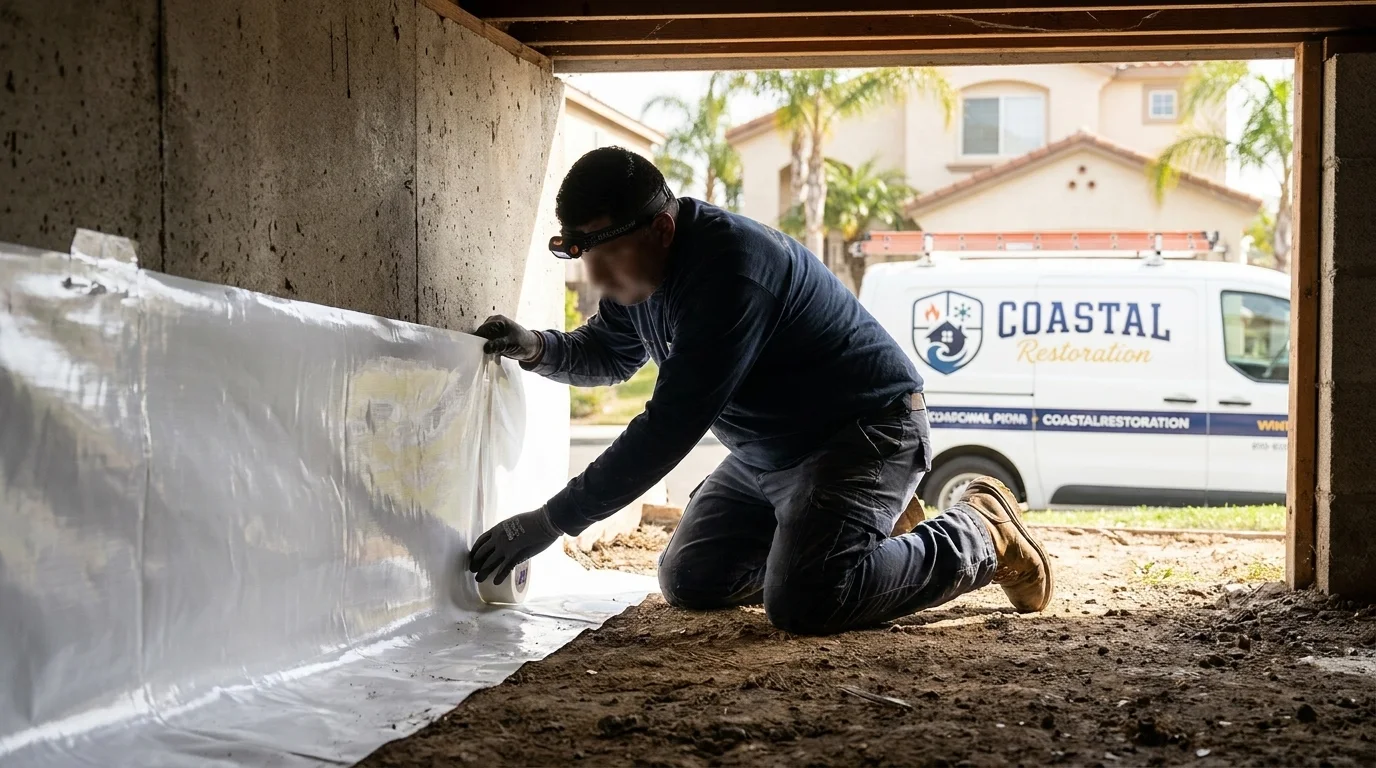
Once the space is cleared and dried to an acceptable baseline, the crew installs a heavy-gauge reinforced polyethylene vapor barrier, typically 20-mil, across the entire dirt floor and up the foundation walls, sealed at all seams and termination points with manufacturer-rated tape. Vents are sealed or conditioned depending on the home’s mechanical configuration. In Ballard’s climate, where exterior humidity is high enough that passive venting can actually introduce more moisture than it removes, conditioning the crawl space and tying it into the home’s HVAC envelope is often the more effective long-term strategy.
If elevated humidity persists after the liner is installed, a crawl space dehumidifier sized to the square footage of the space is added and plumbed to drain automatically. That unit runs continuously and keeps relative humidity in the crawl below the 60 percent threshold where mold and wood-destroying organisms thrive.
What the Encapsulation Work Actually Addresses
A properly encapsulated crawl space does several things at once. It eliminates the direct vapor pathway from soil to subfloor, which is the primary driver of moisture-related wood damage in coastal homes. It also reduces the stack effect, the phenomenon where air from the crawl space gets drawn upward into living areas, carrying mold spores, soil gases, and musty odors with it. Homeowners frequently report that floors feel warmer and that the musty smell they had attributed to “old house” character disappears within weeks of encapsulation.
For properties where previous moisture intrusion has already caused insulation damage or early-stage mold growth on joists, encapsulation is paired with remediation of the affected materials before the liner goes down. Sealing over active mold growth is not an acceptable outcome, the liner would simply preserve the problem in an anaerobic environment.
Local Note
One pattern that comes up repeatedly in homes along this stretch of the California coast: original builders in the mid-twentieth century often installed fiberglass batt insulation between floor joists with the kraft paper facing oriented downward, toward the crawl space, rather than upward toward the conditioned floor. In a dry climate that installation detail is a minor code curiosity. In Ballard’s persistently humid conditions, it means the vapor retarder is on the wrong side of the assembly, actively trapping moisture against the wood rather than managing it. When the crew finds this configuration during inspection, the batts typically need to come out before encapsulation proceeds. It is a detail that does not show up in a surface-level estimate but makes a significant difference in long-term performance.
If you are noticing soft flooring, condensation on ductwork beneath the house, or a persistent damp smell that worsens in the morning, those are reliable indicators that the crawl space is driving the problem. Call Coastal Restoration Services Inc at (805) 345-7440 to schedule an inspection, the sooner the moisture source is addressed in Ballard’s climate, the less secondary damage accumulates in the structure above it.
Serving Ballard from our Santa Maria headquarters — ★ 5.0 · 29 Google reviews
“Tony and his crew did a fantastic and quick job to repair the first floor water damage of our condo! Great work at a very reasonable price!!” — John, July 2026Read our reviews on Google →
Crawl Space Encapsulation in Ballard: Service Coverage
Frequently Asked Questions
How fast can you arrive for crawl space encapsulation in Ballard?
How does Ballard's coastal climate affect how long a crawl space encapsulation project takes?
Are homes in Ballard more likely to have existing mold growth in the crawl space before encapsulation begins?
Does the type of foundation common in Ballard affect which encapsulation approach is used?
What is the difference between a standard vapor barrier and full crawl space encapsulation for a Ballard home?
Can crawl space encapsulation in Ballard be covered by a homeowner's insurance policy?
Crawl Space Encapsulation response in Ballard
Most Ballard calls see a technician on-site within 60 minutes from our Santa Maria headquarters.