TL;DR: If your washing machine flooded your house, shut off the water supply valve behind the machine and cut power to any wet outlets before you do anything else. Call a licensed plumber to stop the leak and a water damage restoration company to start extraction and drying, since drying needs to begin within hours to avoid mold. Whether insurance covers it depends on whether the failure was sudden (usually covered) or a slow, known leak (usually not).
If you’re standing in a laundry room with water spreading across the floor into the hallway right now, stop reading the long version and do three things: shut off the valve, cut power to anything wet, and get absorbent materials off the floor. The rest of this covers who to call, what the next two days look like, and what your policy actually pays for.
What should you do in the first 60 seconds?
Shut off the water first, then worry about everything else. Most washing machines have two small valves on the wall behind them, one hot, one cold. Turn both clockwise until they stop. If you can’t find them or they’re stuck, shut off the home’s main water supply instead.
Next, check for water near outlets, power strips, or the dryer’s plug. If standing water is touching anything electrical, don’t step in it. Shut off power to that circuit or room at the breaker panel if you can reach it safely, and leave the area until it’s confirmed safe.
Once the water is stopped and the area is safe, pull up rugs, towels, or anything absorbent that’s sitting in standing water. Prop up furniture legs on foil or blocks if water is spreading toward a living room or bedroom. Don’t run a shop vac on standing water near outlets. This is the point where you start making calls, not where you start mopping for the next hour.
Who do you call first, a plumber or a restoration company?
Call both, but they solve two different problems. A licensed plumber fixes the mechanical failure, a burst supply hose, a cracked valve, or a clogged drain line that caused the overflow. A water damage restoration company removes the water that already escaped and dries the structure before it causes rot or mold.
Most homeowners assume the plumber is the first call because that’s who caused the problem. In practice, the clock that matters most is the drying clock, not the repair clock. Wet drywall, subfloor, and baseboards start supporting mold growth within 24 to 48 hours according to the EPA, so the restoration crew’s arrival time often matters more than the plumber’s.
Coastal Restoration answers calls 24/7 for water extraction, moisture mapping, and structural drying in Santa Maria and Orcutt, and can tell you over the phone whether what you’re dealing with needs a plumber on site too. Call (805) 345-7440 to get a tech dispatched, and call your plumber in parallel if the leak source isn’t obviously stopped by the shutoff valve. Neither company replaces the other. The plumber doesn’t own a truck-mounted extractor or LGR dehumidifiers, and the restoration crew won’t solder a new supply line.
Does it matter if the water came from the supply hose or the drain?
Yes, and it changes what gets pulled out of your home versus what gets dried in place. Water from a burst supply hose is Category 1 water under the IICRC S500 standard, meaning it started clean, from a sanitary source.
Water that backed up or overflowed from the drain hose or the machine’s internal drum is a different story. That water has already picked up detergent residue, soil, and grease from laundry, which classifies it as Category 2, or gray water. Gray water calls for more aggressive cleanup: wet carpet pad usually comes out rather than getting dried in place, and affected baseboards or laminate flooring often need removal instead of just drying, because the contamination sits inside the material, not just in it.
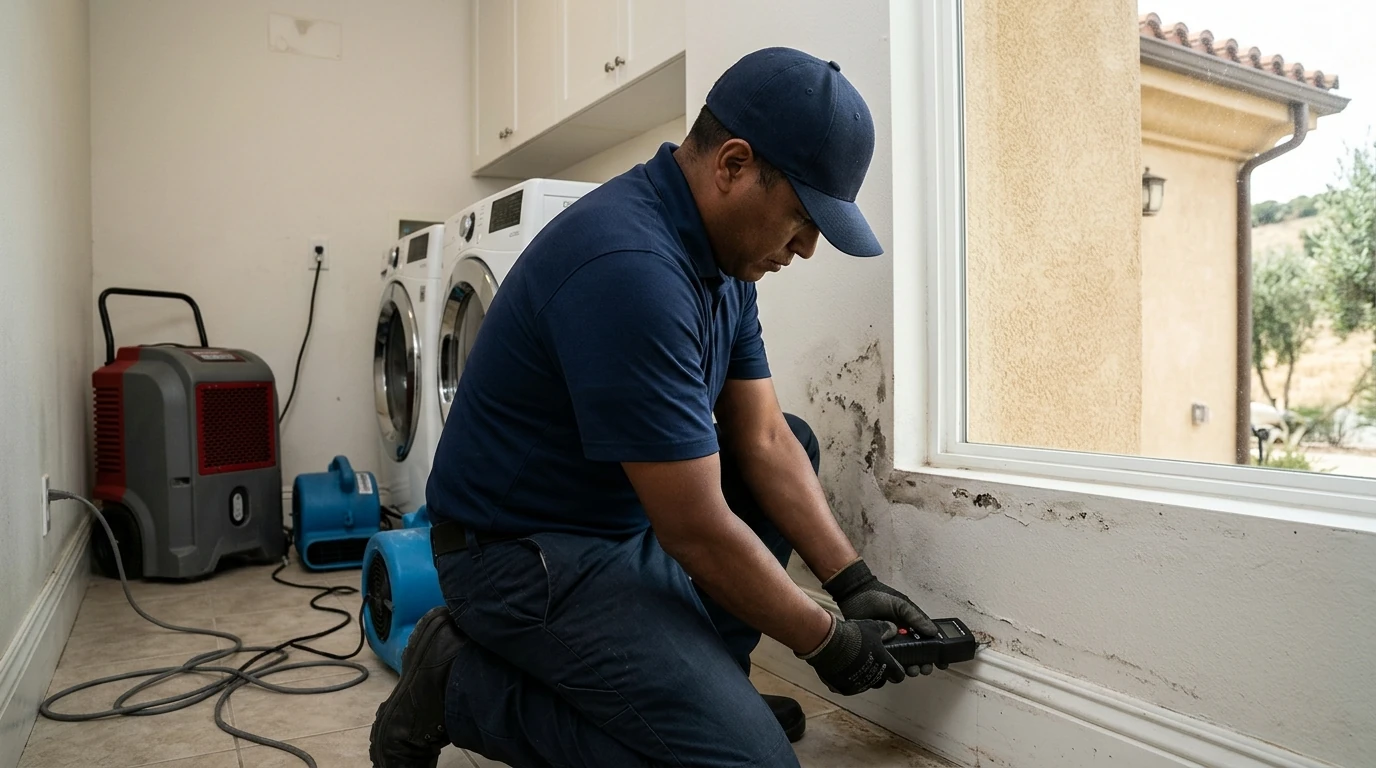
Either category of water wicks fast under laminate flooring and behind baseboards, traveling well past where the puddle on the surface ever reached. A tech with a moisture meter checks subfloor readings in a grid pattern specifically because the visible wet line on the floor is rarely where the water actually stopped.
What happens in the first 24 to 48 hours?
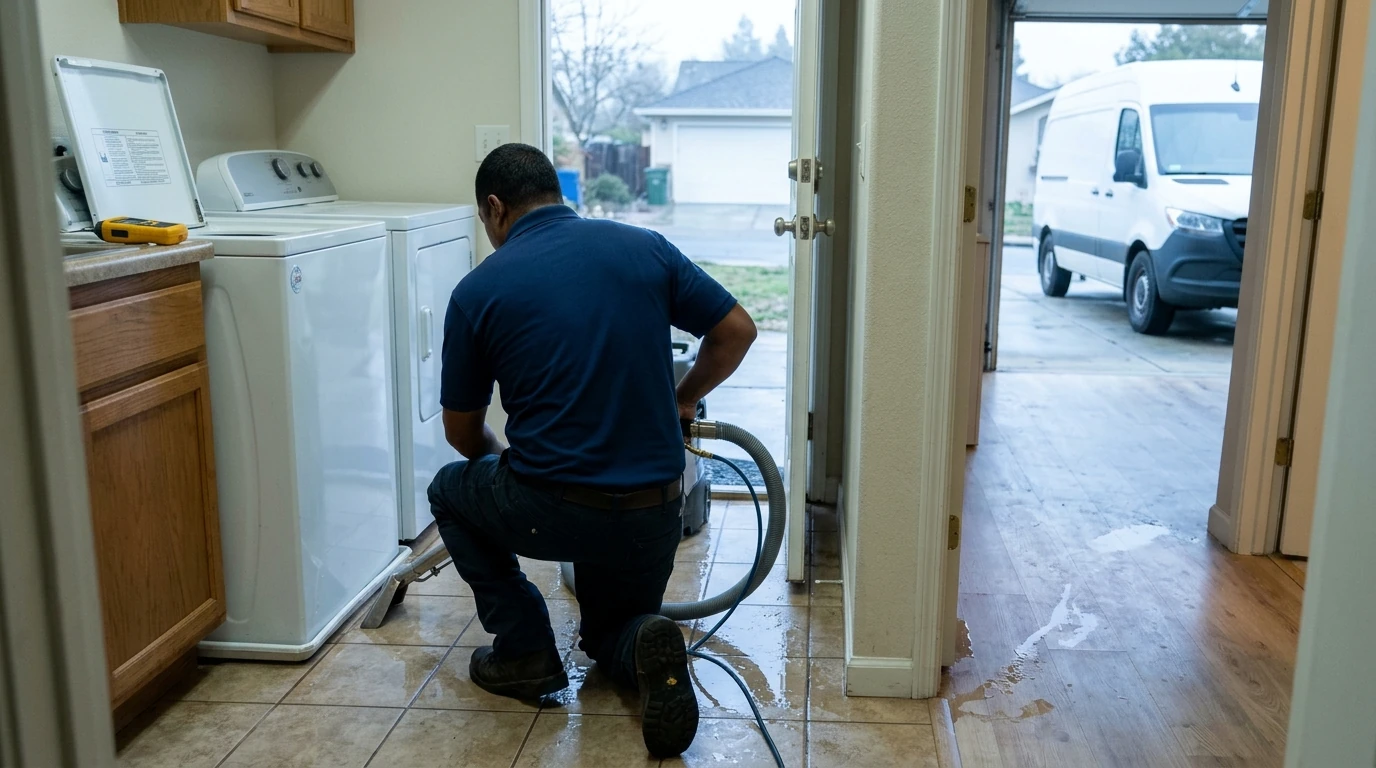
The first visit is about measuring, not guessing. A restoration tech uses a moisture meter and sometimes a thermal camera to map exactly how far the water traveled under flooring, behind baseboards, and into adjoining rooms, then documents those readings with photos.
Extraction comes next, pulling standing water out with a truck-mounted or portable extractor, followed by targeted demolition if the water category calls for removing wet baseboard, carpet pad, or laminate rather than drying it in place. Air movers and dehumidifiers go in to bring the structure down to a dry standard, typically checked daily over 3 to 5 days depending on how much material got wet and how enclosed the space is.
This is also the window where mold risk is decided. Drywall, subfloor, and cabinetry that stay wet past 48 hours without active air movement are far more likely to need remediation later, not just drying. Getting equipment running within hours of the flood, not days, is the single biggest factor in whether this stays a drying job or turns into a mold job. Our guide on what to do in the first 24 hours after water damage covers the drying benchmarks in more detail.
Will insurance cover washing machine flood damage?
Most homeowners policies cover sudden, accidental water damage, which includes a supply hose that suddenly bursts or a valve that fails without warning. What they typically don’t cover is damage from a leak you knew about, or one caused by wear and neglect over months, like a hose that’s been visibly cracking for a year.
Document the failure before anything dries out or gets torn out: photos of the hose or valve, photos of how far the water spread, and a note of when you noticed it. The California Department of Insurance’s residential claims guides walk through what adjusters look for in a sudden-loss claim versus a maintenance dispute. Our own water damage insurance claim tips post covers the documentation steps in detail, and our water damage restoration cost guide for California gives a sense of typical repair ranges if you’re estimating out of pocket exposure before the adjuster calls back.
Once the water is stopped and documented, a written drying scope from a certified restoration company gives the adjuster something concrete to work from, which tends to move claims faster than a homeowner’s own estimate of the damage.
If you’re dealing with this right now, the fastest path forward is getting the water stopped, getting a restoration crew’s moisture readings on record, and letting the paperwork follow the drying, not the other way around.
About Coastal Restoration
Coastal Restoration is an IICRC Certified Firm serving Santa Maria and the Central Coast, with technicians holding Water Damage Restoration Technician (WRT) and Applied Structural Drying (ASD) certifications. The company is licensed (CSLB #11245226) and answers calls 24/7 for water extraction, structural drying, mold remediation, and related restoration work across Santa Maria, Orcutt, Lompoc, and surrounding communities.